It was a rare overcast day in the Rwandan capital but I could feel the excitement simmering in the air. The grey shadows cast by the expansive clouds floating through the Kigali sky contrasted starkly with seas of bright soccer jerseys that rolled like waves toward Amaroho Stadium, which loomed in the distance like the Colosseum in Rome.
It was in this theater of sport where the two titans of Rwandan football were about to clash. Motorcycles buzzed through the streets like wasps; pedestrians weaved like minnows through rush-hour traffic, all while law enforcement was doing their best to control the streets.
It was an uncharacteristic scene of chaos in a city known for its orderliness. I found my friend, Bienvenue, smiling and waving to me on a street corner across from my hotel. It was just days ago when we first met that he invited me to this game.
“It is called the Thousand Hills Derby,” he told me. The two biggest teams in Rwanda, both from the same city, were about to collide in hopes of winning a trophy called the Peace Cup. It was just as though Manchester United was facing Manchester City in the FA Cup final, or if Inter Milan clashed with A.C Milan in the finale of the Coppa Italia.
To Rwandan football fans, this game meant everything.
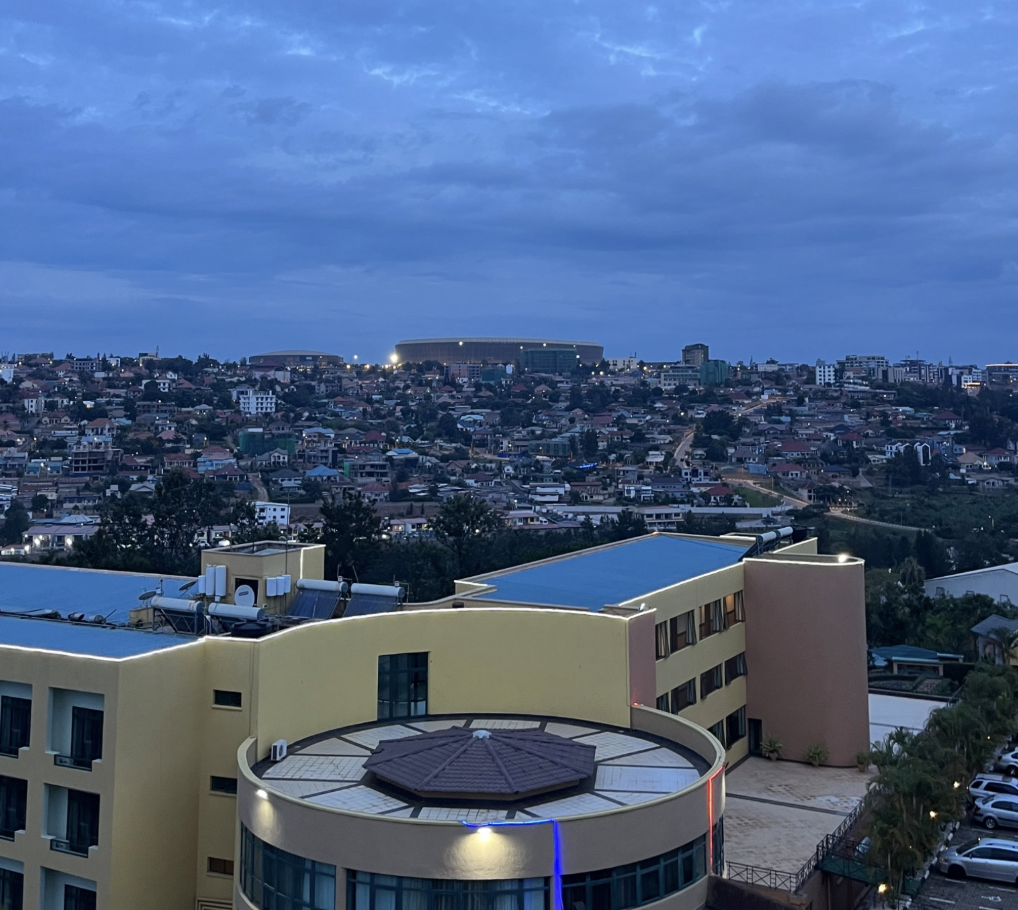
After we moved closer to the stadium, we could see that line to get in snaked endlessly down a cobblestone street. Luckily, because Bienevenue had his neighbor’s young daughter Ineza with him, the security guard allowed us to skip to the front of the line. When we made it through the final security checkpoint, the chaos briefly subsided.
I paused for a moment to gaze at Amahoro Stadium, which shimmered like gold beneath the setting sun that had begun to peer between the dissipating clouds. The outer shell of the stadium was striped with geometric patterns reminiscent of those on the straw baskets prevalent in Rwandan homes and businesses. The stadium’s oval shape reminded me of the famous Allianz Arena, where I had been just over a month earlier to watch the German giants, Bayern München, play in a Champions League knockout match. The Rwandan football league would pale in comparison to the level of football on display in the Champions League, but the atmosphere outside the stadium matched, if not exceeded, that at the Allianz.
As we made our way into Amahoro, the sounds of rhythmic whistling grew louder, songs echoed through the halls of the arena as did the voices of vendors selling whistles and air horns.
Welcome to football in Africa,” Bienvenue said.
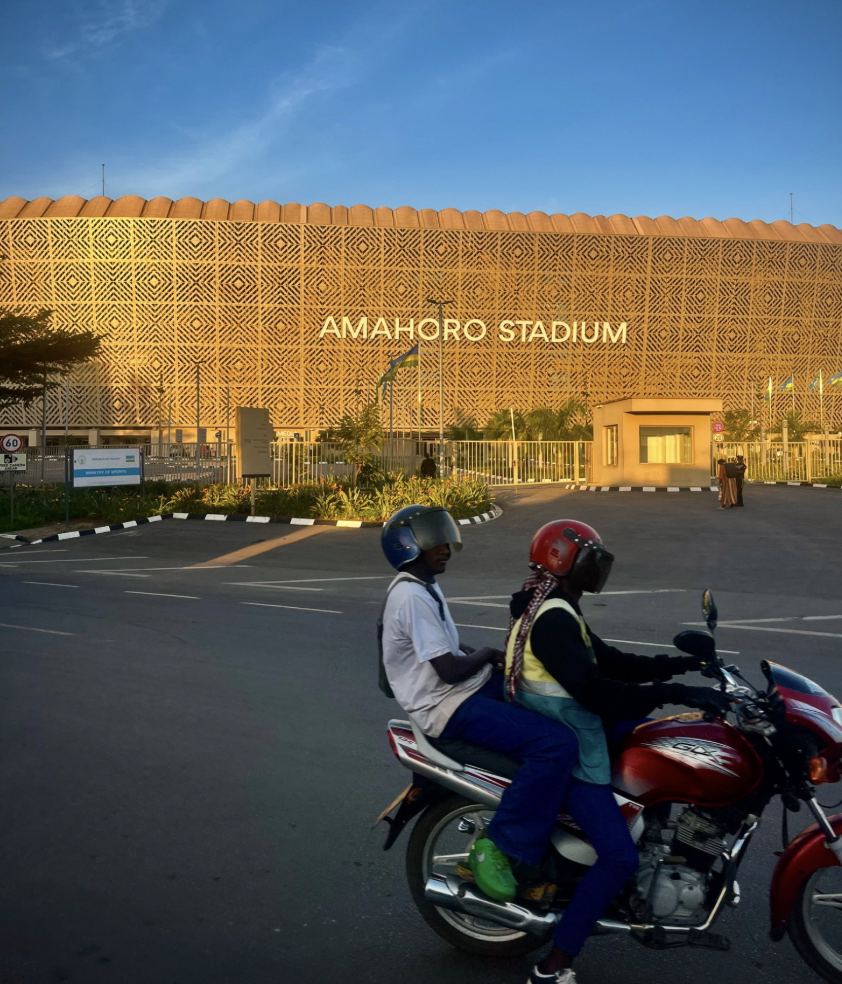
As we reached our seats an hour before kickoff, the sound of Vuvuzelas thundered through the stadium and added to the cauldron of noise. Vuvuzelas, first introduced to the global stage at the 2010 World Cup in South Africa, are simple plastic horns, but when played in mass, they produce a sound akin to a thousand trumpeting elephants. The unmistakable sound can only be described as pure nostalgia to my generation of football fans who grew up watching highlights of Tshabalala’s immortal opening goal for South Africa, and Iniesta’s Biblical finish that canonized Spain as champions of the footballing world.
The modern sound of world-famous Afro-beats that pumped through the stadium stereo system brought me back to the present, where Rwandans on both sides of the stadium moved together in sync to the beat of each track. Suddenly, the familiar opening notes of Gala’s song “Freed From Desire” rang out through the stadium, and my eyes lit up as I turned to Bienvenue.
“This is one of my favorite songs!” I exclaimed.
The remainder of the stadium simultaneously recognized the tune as the crowd erupted into song. The lyrics were not in their first, or for some not even their second language, but they knew the words. My years of watching Premier League soccer conditioned me to know every word of the song as it is always played in stadiums across England to celebrate large victories.
In this case, the game had not even begun, and the fans were bouncing as if they had just witnessed their team win the final. The hour-long pregame dance party was interrupted by a loud roar that shook the stadium as the two teams walked out onto the field. The mood shifted as the two teams faced each other like warriors sizing each other up before battle. The two sets of fans were in competition as well, as the roars of the adequately nicknamed Rayon Sports Lions clashed with the thunderous shouts from the Giants of APR.
Then there was silence…

“This is the moment of silence to remember the 1994 Genocide against the Tutsi,” Bienvenue whispered.
In the 60 seconds of silence that seemed to last a lifetime, I remembered a moment from an earlier visit to the Kigali Genocide Memorial. Maurice Kwizerimana, a survivor of the genocide and now an ambassador at the Kigali Genocide Memorial, had told me that “Forgiveness is the foundation of the house we are walking on… the house that is Rwanda.”
With these words fresh in my mind, I looked out on a stadium separated by team allegiance but united by their shared Rwandan identity. I was not just witnessing a football match but rather a living, breathing example of the power of human compassion and resilience.
Then, a vuvuzela blared. The match was about to kick off.
I wiped a tear from my eyes while my heart raced with excitement. I could tell I was not the only one who had been taken over by emotion during the moment of silence. I thought back to the words of Mark Frohardt, a former deputy chief of the UN’s Human Rights Mission in Rwanda: “Everything you do in Rwanda has to be done in the context of the genocide.”
Tutsi refugees sheltered in Amaraho Stadium 32 years ago while genocidal forces told them to start digging their own graves as the world forgot about them. On this day, in the same stadium, I was witnessing 40,000 Rwandans laugh, dance, and sing together as if it were a scene from a fairytale movie of Rwanda’s reconstruction.
The fairytale for Rayon Sport supporters, however, was just getting started, as their team won a penalty kick midway through the first half. Their fans, now covered by a hovering haze of blue smoke, were already celebrating as if the ball had hit the back of the net. Seconds later, the ball rippled the net, Rayon had scored. As blue and white flags waved fervently beneath the blue smoke that lifted over the Rayon supporters section I began to feel for Beinvenue. He had chosen to support APR in this match but his team was clearly going down.
“They look like they have no plan when they go forward…” I said. “It reminds me of Liverpool this season.”
Bienvenue nodded in agreement.
Their attack has not been good today,” he said.
But seconds later, a brilliant cross from APR’s number 10 found the head of their lurking striker and sent the ball barreling through the keeper’s hand and into the side netting. With just minutes left to play, APR had equalized, once again proving why they are nicknamed the Giants. Their fans released 80 minutes of pent-up anxiety and frustration into a groundshaking, raucous celebration that would continue until the final whistle blew. The match had built up to a crescendo, and now it was anyone’s game to win as they headed directly into a penalty shootout.
“I think we can go now… I need to get her home,” Beinvenue said, motioning toward young Ineza, who had clearly grown tired. Reluctantly, I agreed, as memories flooded back of my parents dragging me out of Atlanta United games when I was younger so we could beat the traffic.
As we left the stadium and found our way down the quiet cobblestone street that had been buzzing with excitement just hours earlier, we heard roars echoing in the stadium behind us as the crowd reacted to each shot. Bienvenue stopped us at a bar near the stadium, where he went in to buy me water. In the meantime, Ineza and I were captivated by the television screen on the wall outside, playing the game to the bar patrons and others who gathered around the bar’s perimeter. Even two men, whose game of pool had been reduced to just the 8 balls to make, paused to watch the screen perched at an awkward angle on the red-painted wall.
Bienvenue returned with the water and found us staring at the TV, and decided we had to watch the final few kicks. The tension rose with each kick as the eyes of those in the bar were so heavily fixated on the game that they had hardly noticed the muzungu watching along with them. Finally, a Rayon Sport miss meant that APR had a chance to win the game with a successful penalty kick. The kick taker stepped up slowly, but his shot rocketed into the back of the net in a blink as joyous screams from those around rang out, and the distant roar of the stadium could still be heard like the sound of a jet engine thundering overhead.
As we stepped out into the street, young children and teenagers darted past us in the direction of the stadium as they hoped to join the celebrations. Motorcycles flew past us in fleets, blaring their horns, some carrying passengers banging on jerry cans like drums.
Bienvenue turned to me.
“This is why I love football, because it makes people happy,” he said.
I smiled because he had unknowingly just summarized the exact reason why I love football, too. As we made our way further down the street, a group of motorcyclists gathered, driving around in circles, beeping their horns while a crowd of all ages gathered to watch and sing with excitement. The scene instantly reminded me of a similar moment I experienced in Rome after AS Roma won a Europa League match with a last-minute goal, and the streets were flooded with motorcycles and vespas.
Perfectly on cue, Bienvenue smiled and spoke, as though he had read my mind.
This is what happiness looks like everywhere,” he said.

Daniel McHugh was a student in the Travel Journalism program in Rwanda during summer 2026.


After reading this article I found myself to that days Thank you Daniel MacHugh
Great article, beautifully written, interesting and informative. Having known the author for all his life as a child with few words I am amazed and so impressed. Good job Daniel, keep writing!
Opa