A Strawberry Legacy is Replanted at Merk Farm

Early summer Saturday mornings at the Merk Farm in Commerce, Georgia, have taken on a whole new meaning after Ali Merk introduced strawberry season.
After waking up before the sun and fueling with coffee, Ali doesn’t have a moment to sit. She handles the full load of daily labor: watering the plants, tending the cows, the pig, and the goat and managing the marketing for the farm’s events.
By the time the sun is up, she is in the concession stand selling treats she whipped up from scratch or out in the fields, helping families find the ripest berries. A heavy workload, but Ali handles it with grace and toughness.
I’m a princess, but I also happen to know how to run a chainsaw,” she said.
She may call herself a princess, but she’s one who prefers a pair of red-clay stained boots and garden shears over a palace.
This year, Ali has planted 22,000 strawberry plants, specifically the Ruby June and Camarosa varieties — berries that can’t be found on a local grocery shelf. These berries are a deep, bright red all the way to the green leafy stem and taste like sweet strawberry preserves. They are the reason patrons are willing to drive for hours just to pick.

It’s a trend that is sweeping the state, which now lists more than 430 agritourism destinations, according to the UGA Extension. While direct visitor spending in Georgia reached $36.8 billion in 2024, the 2026 Georgia Ag Forecast projects a continued traveler preference for less-crowded, nature-based and experiential destinations.
For Ali, it has been more than being a part of a billion-dollar industry; it’s about legacy and the quality found in every bucket.
We want these to be the best strawberries that anyone has ever had,” Ali said.
Ali grew up getting dirty on her grandparents’ farm in South Florida. From fishing, working on the farm and testing out the ripe strawberries, Ali knew from a young age that this was the type of living she wanted forever.
In 1992, Ali moved to rural Jackson County when her mother took a job at a local hospital. She spent her childhood returning to her grandparents’ farm, until it was eventually lost to suburban development. Even without her own farm, her grandmother, ‘Gram’ Roslund, traveled to strawberry festivals well into her eighties.
“She was the strawberry queen,” Ali said.
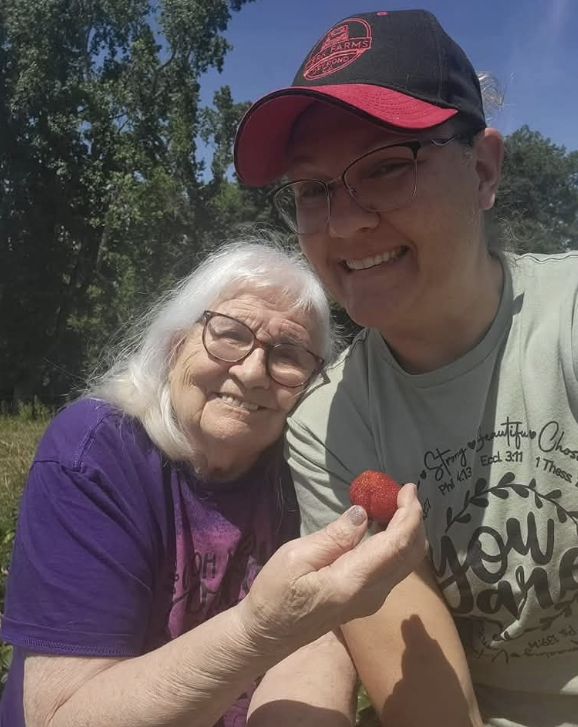
Ali had a lifelong dream to continue her grandparents’ strawberry legacy — a vision that all became possible when she married Phillip Merk, who worked on his father’s farm. What started out with horse-drawn plows in cotton fields and raising beef, the Merk Farm has now evolved into something much bigger, thanks to Ali.
Ali had goals to not only have her own strawberry fields, but to also have a farm that welcomed visitors. She knew she wanted to introduce agritourism to the Merk family, but was intimidated to change the rhythm of a farm that had been family-run for over 120 years.
“Who would take on a risk like this?” Ali asked.
But, she convinced Phillip to pursue her dreams of continuing her grandmother’s strawberry legacy right there, on his family farm. By 2024, Ali had picked her first strawberry from the farm, a memory that she will have forever.
“Normally those first few strawberries aren’t the best, but we were all so thrilled,” Ali said. “We all stood in the kitchen and each shared a bite of that first strawberry.”
It didn’t take long for the word to spread about Ali’s sweet strawberries, reaching families as far away as Atlanta. Since 2020, the Stark family has been driving over an hour not just for the strawberries, but for the woman who grows them.
“One time, there were some people picking in the fields on a hot day, it looked like a family that could use some love, and we watched her bring out some water, maybe some treats to them,” Ben Stark, a returning patron whose family has grown close to Ali, said. “She was just very kind to them, and no matter what life you’re walking, she’s always very friendly.”
And while Ali has fulfilled her dream of continuing her grandmother’s legacy, she has built community and friendships through agritourism at the Merk Farm, something that she did not see coming.
I had not prepared myself for the emotional tie to people,” Ali said. “It really is profound, nothing short of profound.”
Also a teacher in the Young Farmer program, Ali is planting seeds in the community as well as the ground. When she’s not on the farm, Ali teaches high school agriculture classes and works with farm families to help them with their farming practices or ensuring that they have the resources that they need.
Ali’s influence does not stop in her school; it’s also shaping the future of the Merk family farm. Her son, Gabe, has watched his mother transform the farm’s traditional roots into a thriving business, and he knows exactly what that devotion means for his own future.
“If it was not for my Mom’s effort, there might not be a future for me on the farm,” Gabe said.
For Ali, that first strawberry season was about much more than growing agritourism on the farm. It meant she had continued the legacy of her Gram Roslund. She was able to visit the farm during strawberry season, before passing away last year.
“For her to actually see it for the first time, it was just spectacular,” Ali said.
Just a young girl from South Florida who loved to play outside, Ali’s dream of continuing her grandmother’s legacy has come true in recent years. From learning to love a fresh, ripe strawberry with her grandmother, to now creating traditions for families in Georgia to pick from her strawberry fields, perhaps Ali has earned the title of “Strawberry Princess.”
Anna Willilams is a journalism major in the Grady College of Journalism and Mass Communication.