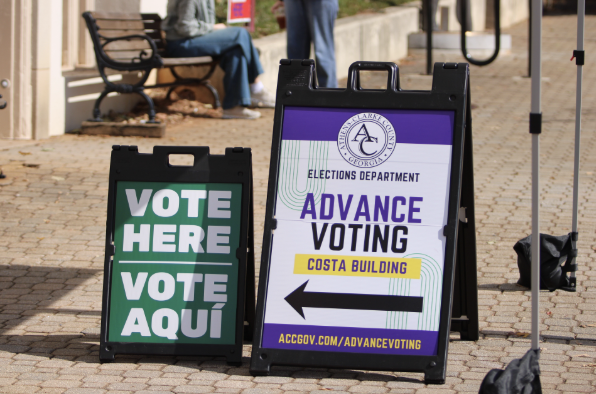
Early voting lasted two weeks in Georgia — from Oct. 13 to Oct. 30 — and registered Athens voters chose to come to the polls early this midterm cycle for reasons such as work, family life and class schedules.
About 41,000 students live in Athens-Clarke County, representing 31% of the population, according to the Athens-Clarke County website.
Brayden Marsh, a law student at the University of Georgia, voted for the first time in Athens-Clarke County. Marsh said the first year of law school can be busy, and early voting allows him the flexibility he needs.
“It gives me the ability to kind of pick when I’m able to do it at my leisure rather than have to do it all at once where I might not have time,” Marsh said.
More than 25,400 early in-person votes were cast in Athens-Clarke as of Oct. 30, according to the Georgia Secretary of State’s office.
Mark Campbell, an Athens-Clarke County election office volunteer who has lived in Athens for five years, said the obligation of voting can be stressful, and voting early gets it off people’s minds.

“I ask people ‘How do you feel now that you voted?’” Campbell said. “‘It’s off my back. I don’t have to worry anymore.’”
Alicia Benetz and Zebulon Weeks voted early to avoid the long lines on Election Day. Weeks, an eight-year Athens resident, went to vote on his lunch break.
“Once you vote on Election Day, it’s always crowded every time I go, so it’s just a lot easier to hop over here on my lunch break,” Weeks said.
Benetz, who has lived in the Pulaski Heights neighborhood for eight years, said she hopes that everyone is able to vote if they can. An estimated 63.82% of workers in Pulaski Heights work more than 35 hours a week in 2024, according to the Census Bureau.
“If we can all get our voices heard, then we can discuss politics together, because nobody gets to argue politics with me if they don’t vote,” Benetz said.
Lee Smith, a Pulaski Heights resident of 38 years and local business owner, also votes early.
The early voting window makes it easier with my work schedule,” Smith said.
Smith encourages his employees to go vote on Election Day, knowing that work schedules can become hectic.
Pulaski Heights has less registered voters than other, larger neighborhoods in Athens-Clarke County, with only 288. They are holding their own for early voting turnout with an early voting rate of 26% registered voters, compared to the Athens-Clarke County turnout of 31%, as of Oct. 29.
“We try to encourage our employees to vote,” Smith said. “So, we tell everyone on voting day that if they haven’t voted, they have our permission to leave work and go vote.”
Monika Kapousouz, poll manager at the Athens-Clarke County Elections Office in downtown Athens’ Costa Building, said anything can happen on the way to the polls, so early voting eliminates the possibility of mishaps.
“You might get sick, you have a family emergency, you have to go out of town, you have a flat tire,” Kapousouz said. “Why not get it over with when the opportunity is there for three whole weeks?”
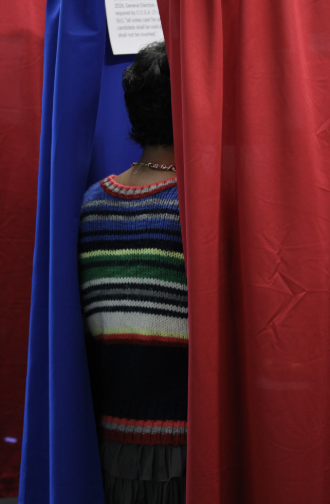
Lisa Calvert said she knew she’d make it to the polls before Nov. 3.
“All my friends had already voted and it must’ve slipped my mind, but I knew I was going to get in before the Election Day,” Calvert said.
Editor’s Note: A surge in advance voting, more than 2.45 million in-person voters as of Oct. 30, 2026, broke previous Georgia records for midterm elections. Reporting II students examined voter registration files and advance voting data for the 2026 midterm elections from the Georgia Secretary of State’s office for Athens-Clarke County to produce a series of stories in a project led by Lori Johnston, journalism senior lecturer, and Mark Niesse, Fink Visiting Professional, a former voting and democracy reporter for The Atlanta Journal-Constitution who now is a freelancer for the AJC, Capitol Beat and PeachPol.