Why ‘70s, ’90s and Y2K Fashion Keep Coming Back
Walk around the University of Georgia campus and you might see low-rise jeans, tank tops, bell bottoms, bandanas and other styles that seem to belong to another era.
For Gen Z, fashion from the 1970s, ’90s and early 2000s has become a source of inspiration. Rather than recreating these decades exactly, students are drawing from the past and incorporating elements of those styles into their own personal identities.
For Sam Tritto, a fourth-year public relations major, the early 2000s have always held a particular appeal.
I think I like it since I was born in 2005 — and I really like 2005 to 2007, it’s like the goated era for me,” said Tritto.
His everyday style reflects some of that influence. He said he regularly wears tank tops and flip flops and gravitates toward casual, low-maintenance clothing.
Tritto also sees a major difference between today’s fashion landscape and the decades that Gen Z is revisiting. In previous decades, he said, there was more of a cultural “monoculture,” with people consuming many of the same movies, music and other media.
A 2022 Business of Fashion report found that social media has accelerated the formation of fashion trends, making it easier for multiple styles and aesthetics to emerge and gain popularity at the same time.
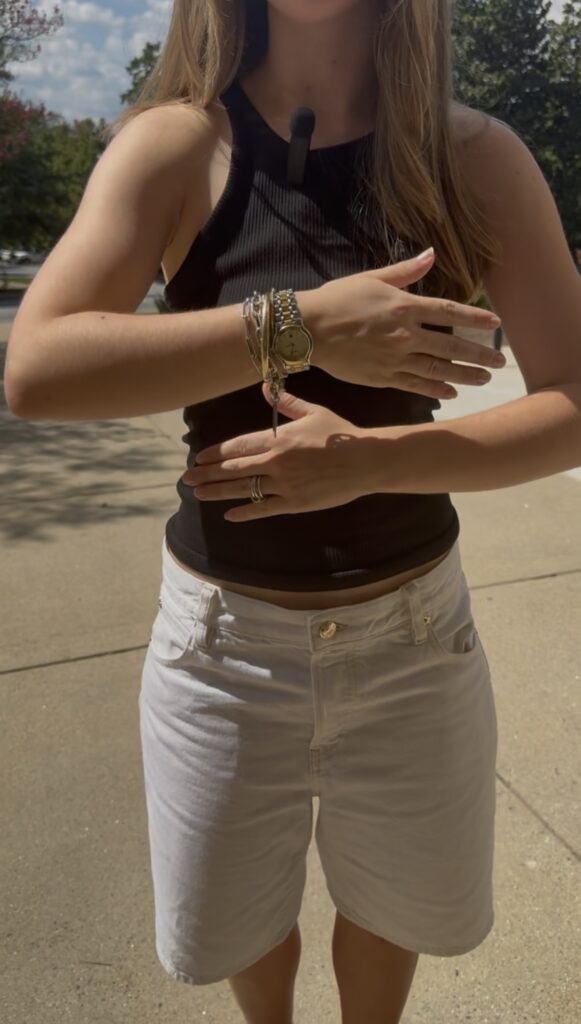
“In most past decades, the monoculture has kind of been a thing,” Tritto said. “Now because of TikTok and the way our media works, we don’t have a monoculture anymore.”
Social Media Brings Past Back
For younger consumers, social media has also made it easier to discover cultural trends from decades they never experienced firsthand.
Heather Anderson, a clinical associate fashion merchandising professor at UGA, said social media allows younger generations to discover old movies, television shows, music and fashion that they otherwise may not encounter.
“I think all of these things have been recurring back because children are on social media,” Anderson said. “Because of social media they learned what it is.”
Streaming services have also introduced younger audiences to older television shows and films, Anderson said, creating new audiences for decades-old pop culture.
That exposure can translate into fashion.
“We’re seeing a lot more of these older shows on streaming devices and people are like, ‘Oh, I never watched that show before,’” said Anderson. “It’s created whole new audiences and people being introduced to things they didn’t know about.”
For Gen Z, that means inspiration from previous decades can be only a few scrolls away.
Looking Beyond Fast Fashion
The resurgence of older styles is also happening as young consumers navigate an industry dominated by fast fashion and constantly changing trends.
Sadie Parker, a fashion merchandising major, said she appreciates the simplicity and longevity associated with some older styles.
“Especially in times now, we are so infiltrated with fast fashion, and it constantly seems like there’s new trends that are just trying to be marketed towards us,” said Parker. “Us Gen Z’ers, we do not want to pay $100-$200 for a piece every single week just to fit in with the times.”
Rather than constantly purchasing new pieces to keep up with trends, Parker said she prefers finding inspiration in styles that feel timeless.
She also sees today’s fashion revival as a way for Gen Z to put its own spin on older trends.
“We’re definitely putting our own modern spin on it,” said Parker.
That individualism can be seen across campus. Students may incorporate elements of a particular decade without committing entirely to one aesthetic.
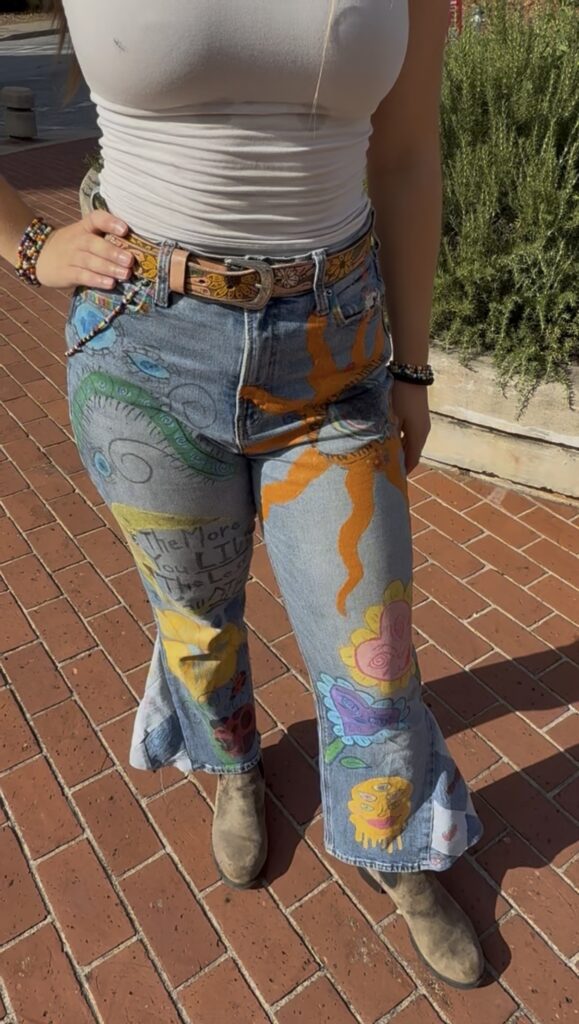
Ella Pattison, a first-year genetics major, said she enjoys incorporating ’70s-inspired pieces into her wardrobe, including bell bottoms, bright colors and bandanas.
“I’ve seen some people who are very dedicated to dressing super ’70s or super ’80s,” Pattison said. “And then there are also a lot of people who are just dressing with the certain spins of taking from previous decades and just using what they like.”
Pattison takes that idea a step further with her own clothing. She spent two months painting a pair of thrifted jeans and sewing a bell-bottom piece onto them, transforming the pants into something uniquely her own.
For her, fashion is ultimately about self-expression.
I think it’s a way that I express myself and it shows that I’m very happy to experiment and try new things and not afraid to stand out,” said Pattison.
Moving Forward by Looking Back
Anderson said the renewed interest in vintage clothing is also connected to the growth of the resale market, with platforms such as Depop, ThredUp and Vinted making secondhand clothing more accessible.
She said older garments can also appeal to consumers because of their quality.
“Those garments that were made back in the 70s and the 80s, a lot of them were made in America and are really good quality, and so they may stick around,” said Anderson.
As resale continues to grow and social media continues to introduce younger audiences to older culture, past fashion trends have plenty of opportunities to resurface.
But today’s students aren’t simply bringing the past back. They’re choosing which pieces work for them and adapting them to fit their own lives.
As Pattison puts it: “Have fun, dress how you want, life is short.”
Kennedy Hill is a graduate student studying journalism and mass communication at the University of Georgia.