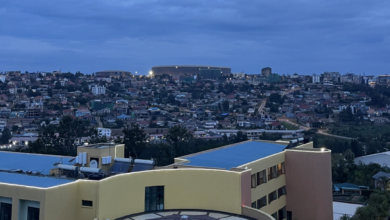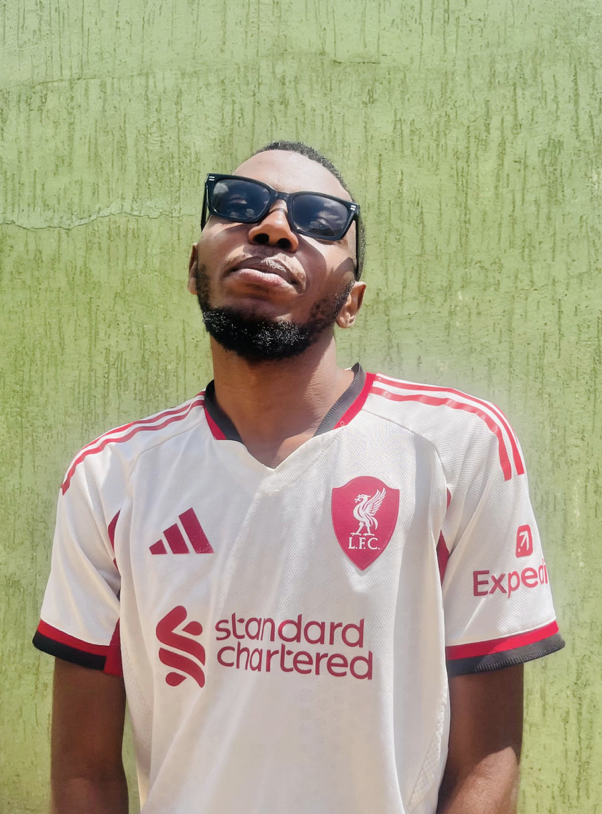
Every New Year in the Rwandan capital Kigali, Rugwiro Shema Kevin attends the fireworks show. The roads around the convention center shut down and families fill the streets, gathering to watch the mesmerizing display. Kevin used to join the festivities every year with his parents. Now, he does it alone. His parents still live in Kigali, he said, they just don’t care to go out.
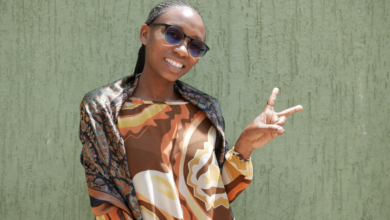
Kevin, a 24-year-old sophomore at the University of Rwanda, stands tall, though he rested on his elbows to meet my gaze when he sat. He had a tightly cropped haircut, a beard, and wore his sunglasses on his Liverpool jersey when I first met him. Despite his shirt, he quickly clarified that he did not support the team, but simply liked the shirt. We both leaned into the sliver of space between our chairs as he told me about his life in Kigali.
Kevin attended public school and often visited different memorial sites and museums on school trips. As he grew into his late teens, he continued to visit the sites memorializing the 1994 genocide with his youth group. Youth groups in Rwanda, he said, were government-organized and ranged in age from teens to the early 30s. They visited memorials to hear personal stories of the genocide, and collect items and donations to give back to the community.
Giving back was a common topic with Kevin. When we spoke about our respective goals, Kevin shared how he wants to become an administrator in Rwanda; he is pursuing a double major in information technology and environmental science to do so. But he also shared that two bachelor’s degrees would not be enough.
“It’s easy to start life in your countries, but in our countries, I think it’s very difficult when you don’t have something like a bachelor’s degree.
Even a bachelor’s degree is not enough for a student to survive in Rwanda,” Kevin said.
He wishes to pursue a master’s degree, then a Ph.D. from the West, returning with his education to build up Rwanda. Education, as in the U.S., is valuable to most Rwandans, Kevin said.
Kevin takes his studies very seriously, and he has since a young age. Unlike most children, Kevin was always dedicated to making high marks throughout primary and secondary school. This drive continued into his college years. But now, Kevin shared, he likes to take breaks every now and then, watching BET shows on YouTube, always looping in his friends.
During our interviews, Kevin shared that he was very sick after finishing high school, and that his illness set him back on starting college by a year. But this was a comparably quick turnaround. Entry into the University of Rwanda is complex, and Kevin relied heavily on his mother during that time. She cared for him during his illness, while also completing the applications and forms needed for Kevin to begin his higher education.
Kevin’s mother took care of her family of seven while his father was a secondary school teacher. He remembers not seeing his father for days. The only laborer in a house with five children, Kevin’s father was always looking for more work.
Kevin shares this hardworking mindset. He freelances as a graphic designer as a side source of income while in college. While graphic design is a good way to work flexibly while continuing his studies, it is not Kevin’s end goal.
“I want to be the minister of health, or be among those high institutions of government,” he said. “I see some problems on the lower level, and I think when I make those high-level decisions, I’ll be able to solve some of them.”
Rwanda’s healthcare system, he said, is advanced, but lacks resources. Many people, he said, have to wait long periods to try to get referrals and appointments. Kevin said it was difficult for many people to get essential care.
Imagine someone who is having, who started having a stroke, waiting for one month,” he said.
The Rwandan government, he said, was doing its best to address these problems, but once again, a lack of doctors and nurses often prevents action.
I asked Kevin how he felt about his next steps, pursuing education in the West. Many Rwandan students, he said, find the work-school balance of Western education difficult, but he isn’t worried.
“I just have this belief where, when you find yourself in a situation, you may adapt; it’s just a matter of time. Just work as hard as you can. You will adapt,” Kevin said.
Everything he did, he said, was to repay his father’s sacrifices.
“That’s why I want to study, make him proud, and I know he will be.”
Hailey Matheson was a student in the Travel Journalism in Rwanda program in the summer of 2026.