‘Toughness Doesn’t Have a Gender’: Jefferson Going All-In on Girls Wrestling

Ava Catledge, Paola Swancey, Peyton Hawkins, Anna Ramirez and Kyndal Brown go through drills as coach Nick White calls them out. (Photo/Lily Grace Kilgore)
The sound of sneakers squeaking on mats echoes through Jefferson High School’s wrestling room as a dozen girls warm up for practice. Sweat drips, laughter cuts through the music, and the energy feels different this year.
“Whenever we’re running laps, we always go back and help people that are struggling that day,” freshman Ellah White said. “We build each other up, not tear each other down.”
For years, only a handful of girls wrestled alongside Jefferson’s renowned boys team. As those numbers grew, the school made a decision that changed everything.
This winter marks the first season Jefferson’s girls and boys teams have been completely separate, each with its own coach. The move gave the girls space to develop, compete and gain recognition.
Across Georgia, schools like Jefferson are responding to a national trend.
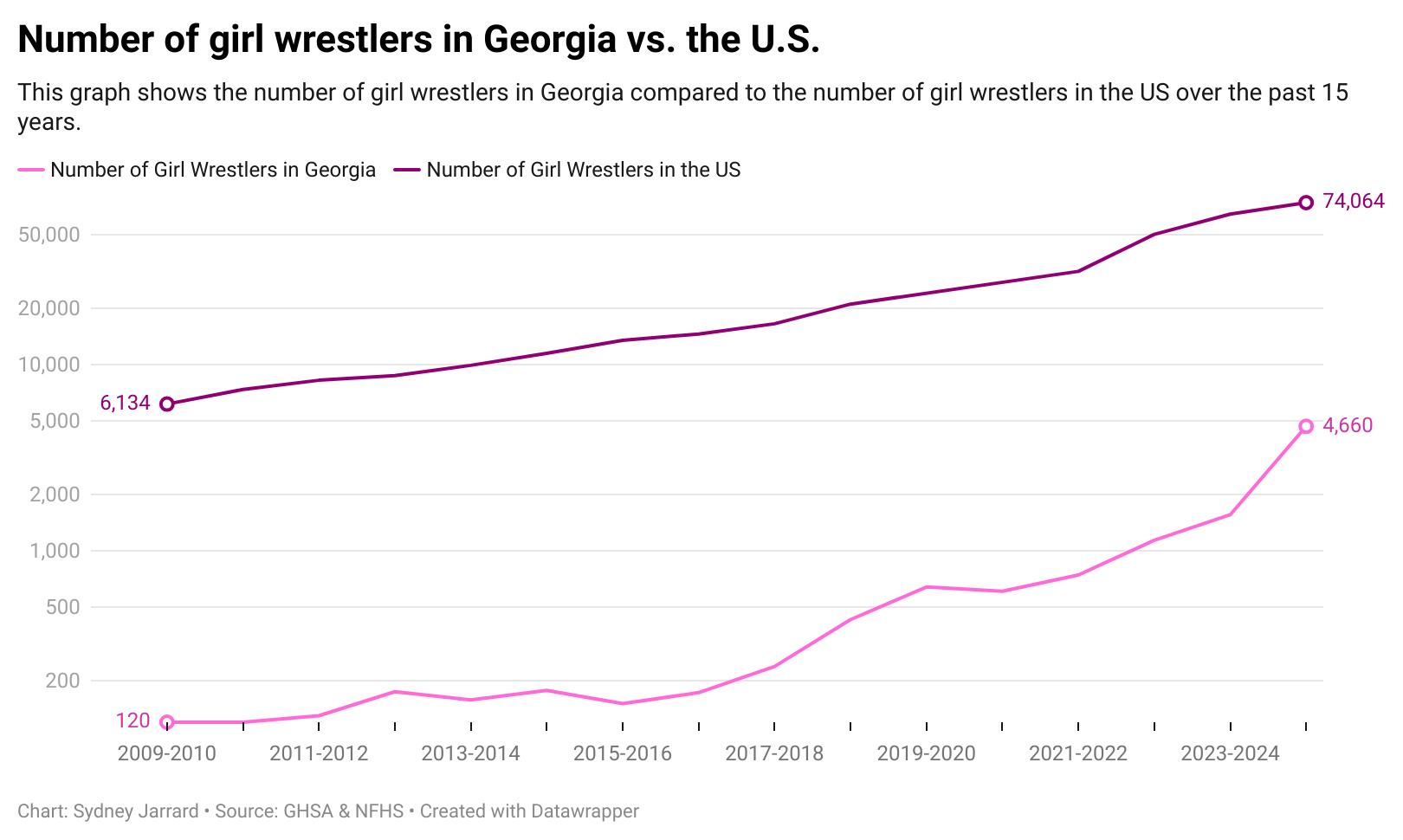
Girls’ wrestling is one of the fastest-growing sports in the country, and participation in Georgia high schools has surged since 2019. Programs that once had a few girls now fill entire lineups, with new teams forming each season.
“Separating the room makes those girls feel a little more safe and secure,” said head coach Nick White, who came to Jefferson this year after building a girls team at Carrollton. “It’s going to encourage more girls to come and join.”
White said the change hasn’t divided the program but strengthened it, adding “We’re all together separate.”
He credited Jefferson’s administration and athletic department for being open to growth.
“They wanted to do it the right way,” White said. “We had the numbers, and the girls deserved a space where they could build their own culture.”
That growth has also reached the college level. Georgia now has several schools with dedicated women’s wrestling programs, including Andrew College, Emmanuel University and Life University, giving young athletes a chance to keep competing beyond high school.
Tristan Bundy, head women’s wrestling coach at Andrew College in southwest Georgia, said the momentum is changing the sport’s landscape.
“The brackets keep getting bigger every year,” Bundy said. “Georgia does it right. There’s one true state champion for the girls. Even qualifying means something.”
White brings 25 years of experience and a calm intensity. He hadn’t planned to lead a girls program, but he and his family felt called to it.
We had no intention of accepting, but on our way home, we just felt like the Lord had his hand in it,” White said. “It’s such a phenomenal community.”
White’s experience at Carrollton is helping shape Jefferson’s newest chapter, one focused less on medals and more on mindset.
“It wasn’t on my bingo card for 2025,” he said. “But this community gets it. They do things the right way. Exposure to excellence creates excellence. Success is a byproduct of culture. If you do things the right way, on and off the mat, success will come.”
That philosophy shows in small moments — encouraging a teammate, showing respect after a tough match or staying accountable through long practices.
“It doesn’t belong to me,” White said. “It’s their program. It’s going to be what they make it.”
For White, the growth of girls wrestling is personal. His daughter, Ellah, a freshman in the 120-pound weight class, wrestles for him.
“I have to treat him like he’s my coach and not my dad,” she said. “I can’t be mad about something from practice once we leave the room.”
Ask any of the girls why they joined, and you’ll hear a mix of reasons: to challenge themselves, break barriers or prove a point.
I don’t think a lot of people understand how hard girls wrestling is,” junior Ella Hughes said. “Each practice is a reminder that toughness doesn’t have a gender.”
Senior Kiersten Green, who wrestled on coed teams before this year, said having a dedicated girls program changes everything.
“It’s refreshing,” Green said. “It’s nice to know the girls coming up after me get the opportunity to be on a team where it’s just girls. It’ll help progress the growth of girls wrestling.”
Jefferson’s roster has nearly tripled over the last two seasons, giving the team enough girls to fill almost every weight class. The team leans on White’s motivation.
“He tells us, ‘It’s never OK to quit today. You can quit tomorrow,’” Green said. “That’s kind of become our thing.”
Looking ahead, Jefferson’s girls team enters the season with a mix of experienced returners and promising newcomers. With several state-ranked athletes and a growing roster, the team is set to compete in upcoming tournaments. Coach White said the focus will be on building skills, supporting one another, and challenging themselves at every match.
“We’ve already got banners printed for girls state titles,” White said. “They’re blank right now but we’re getting ready to fill those things up.”
Lily Grace Kilgore is a student in the undergraduate certificate program at the Carmical Sports Media Institute at UGA.



The most inspiring part of this article isn’t the growing roster or the new banners—it’s that Coach White’s core philosophy, “Success is a byproduct of culture,” was put into action immediately by the girls. When a freshman says the team’s dynamic is about helping struggling teammates during laps, you know that philosophy is already taking root. I’m so curious—do you think this intentional, culture-first approach is the secret ingredient for building successful new sports programs, or is it something unique to wrestling?