Beyond the Trash Can: What Happens to Leftover Food after Sporting Events

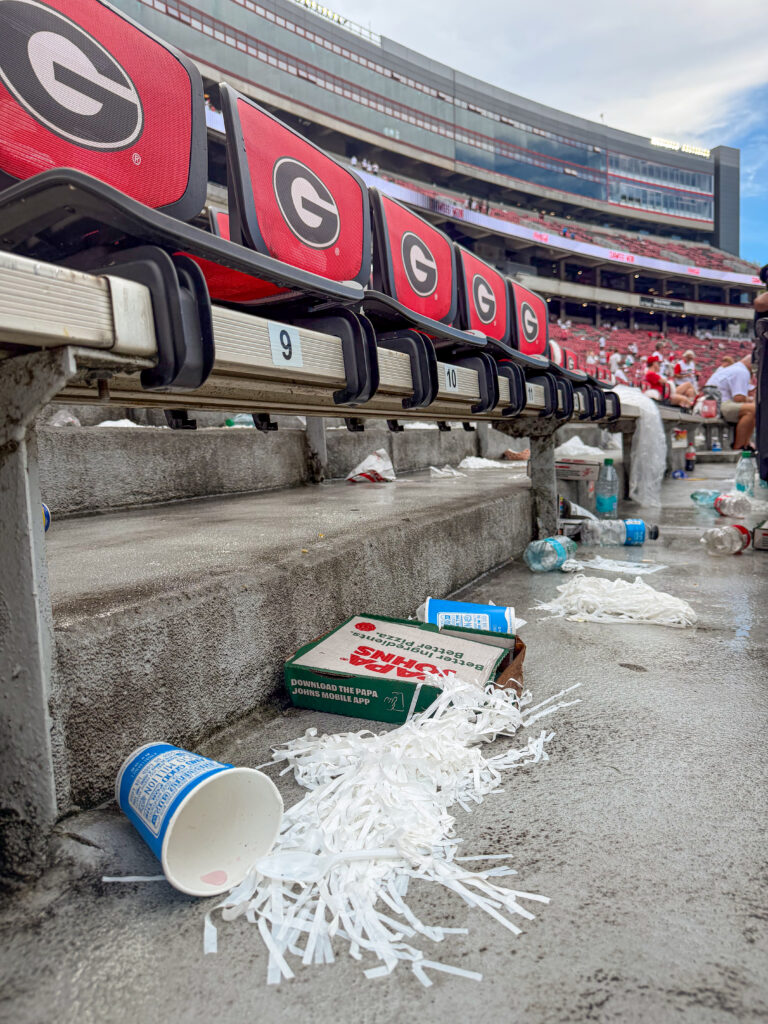
After thousands of fans leave a University of Georgia sporting event, the waste left behind is more than empty cups and food wrappers. Leftover food that is not thrown away can become meals for people in need instead of ending up in a landfill and contributing to methane emissions.
In the past, UGA has implemented food recovery, composting and zero-waste initiatives at its sporting events. A three-game baseball series at Foley Field in 2023 achieved a 91.6% waste diversion rate through recycling and composting, according to UGA.
But food waste remains an environmental concern.
According to the U.S. Environmental Protection Agency, discarded food makes up about 24% of the trash sent to landfills and produces about 58% of the methane released from those dumping grounds. Methane is a greenhouse gas that contributes to climate change.
“I feel like you can visually see the like plastic waste, and you are always taught to recycle. But like behind the scenes, you don’t really get to see all the food waste that you’re creating,” said Caroline Christie, a UGA student and attendee of sporting events.

The Environmental Protection Agency estimates that college football stadiums generate about 0.16 pounds of food waste per visitor, meaning a game with 70,000 fans could generate roughly 11,200 pounds of food waste.
Food waste at sporting events can happen for several reasons, including over preparing food, limited storage and food-safety restrictions.
Large sporting events like football games in Sanford Stadium can produce large amounts of waste, but for some sporting venues, the solution starts before the event even ends.
Second Helpings Atlanta, a food rescue organization, works with food donors, including sporting venues, restaurants, and grocery stores, to collect surplus food and distribute it to nonprofits or feeding programs.
During the 2026 FIFA World Cup, Second Helpings Atlanta collected more than 30,000 pounds of food from Mercedes-Benz Stadium to be donated to local nonprofits, according to Alexei Nikonovich-Kahn, an operations coordinator for the organization. That’s about 15 tons of food, enough to fill several large box trucks.
“Sometimes it’s a few pallets, sometimes it’s over 30 pallets,” Nikonovich-Kahn said when discussing the amount of food available for rescue can vary greatly from event to event.
That variability can make food recovery a logistical challenge. Second Helpings Atlanta works with multiple nonprofit organizations to determine where the food can go based on the amount and type of food available.
Nikonovich-Kahn said one way venues can reduce waste is by preparing food in smaller batches and holding some food back rather than putting everything out at once. Once food is placed on a buffet line or made available to guests, it may no longer be usable for donation.
Second Helpings Atlanta would also be open to partnering with schools like UGA, Nikonovich-Kahn said. He said food recovery at universities can be an opportunity that schools may not know is available or may see as more complicated than it actually is.
It truly is as simple as you give Second Helpings a call,” Nikonovich-Kahn said.
That could be especially useful in Athens-Clarke County, where the food insecurity rate was 20.3% in 2024, according to Feeding America’s food insecurity map. Donations from UGA sporting events could help provide food to people in the community. UGA’s Campus Kitchen, like Second Helpings Atlanta, collects food from restaurants or donors to distribute to people in need, but the organization does not receive donations from UGA sporting events.
Reducing food waste is not only a behind-the-scenes effort. Fans also play a role in what gets left behind after a game.
“Something on the jumbotron or an announcement from Kirby Smart could help fans,” Christie said.
She said a message could remind fans about food waste and encourage them to be more mindful of what they throw away.
While fans can see the popcorn buckets, food wrappers and other trash left behind after a game, much of the food waste is out of sight.
Making fans more aware of what happens to leftover food could be one step toward reducing waste and offering more usable food to people in the Athens community.