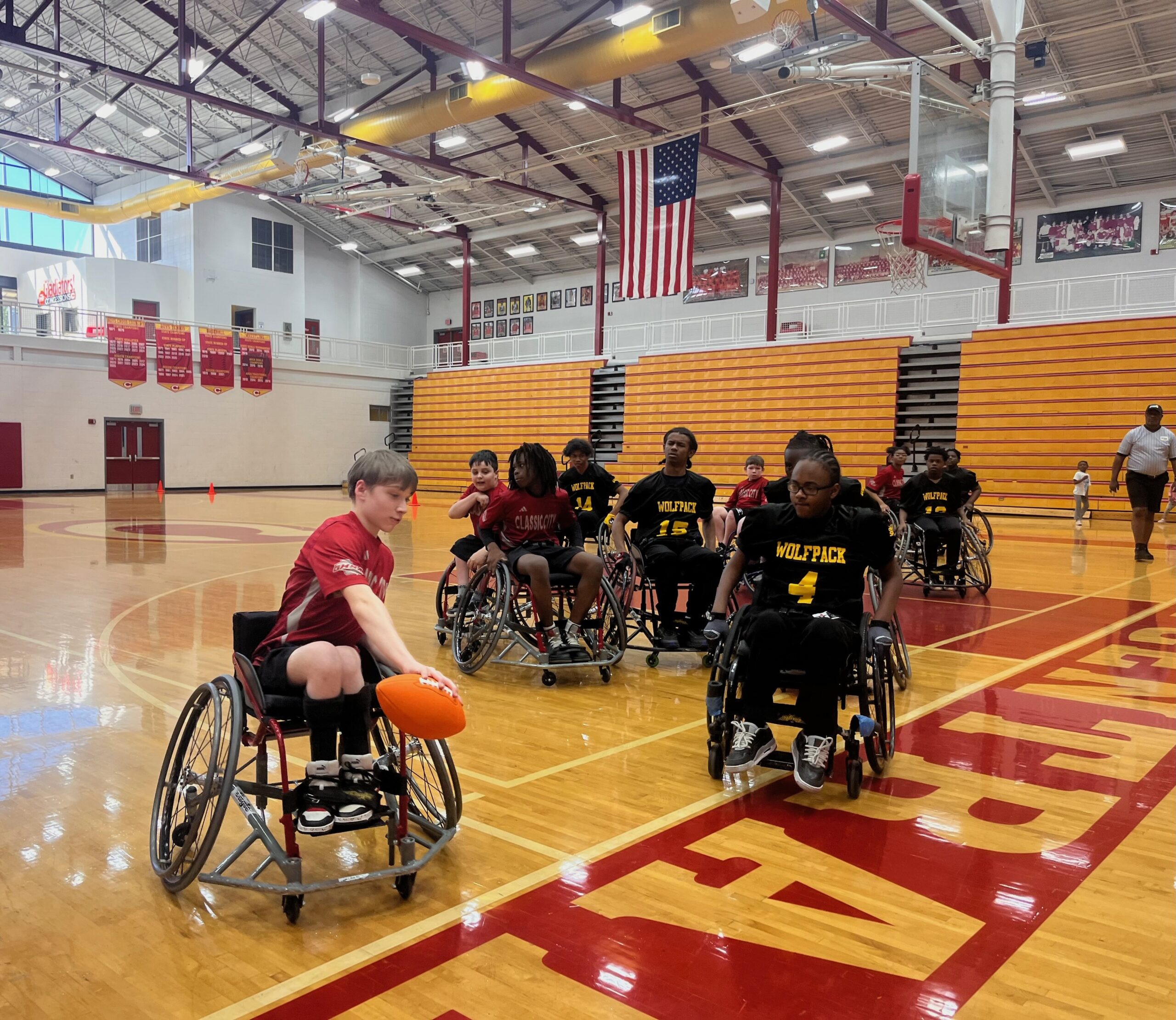
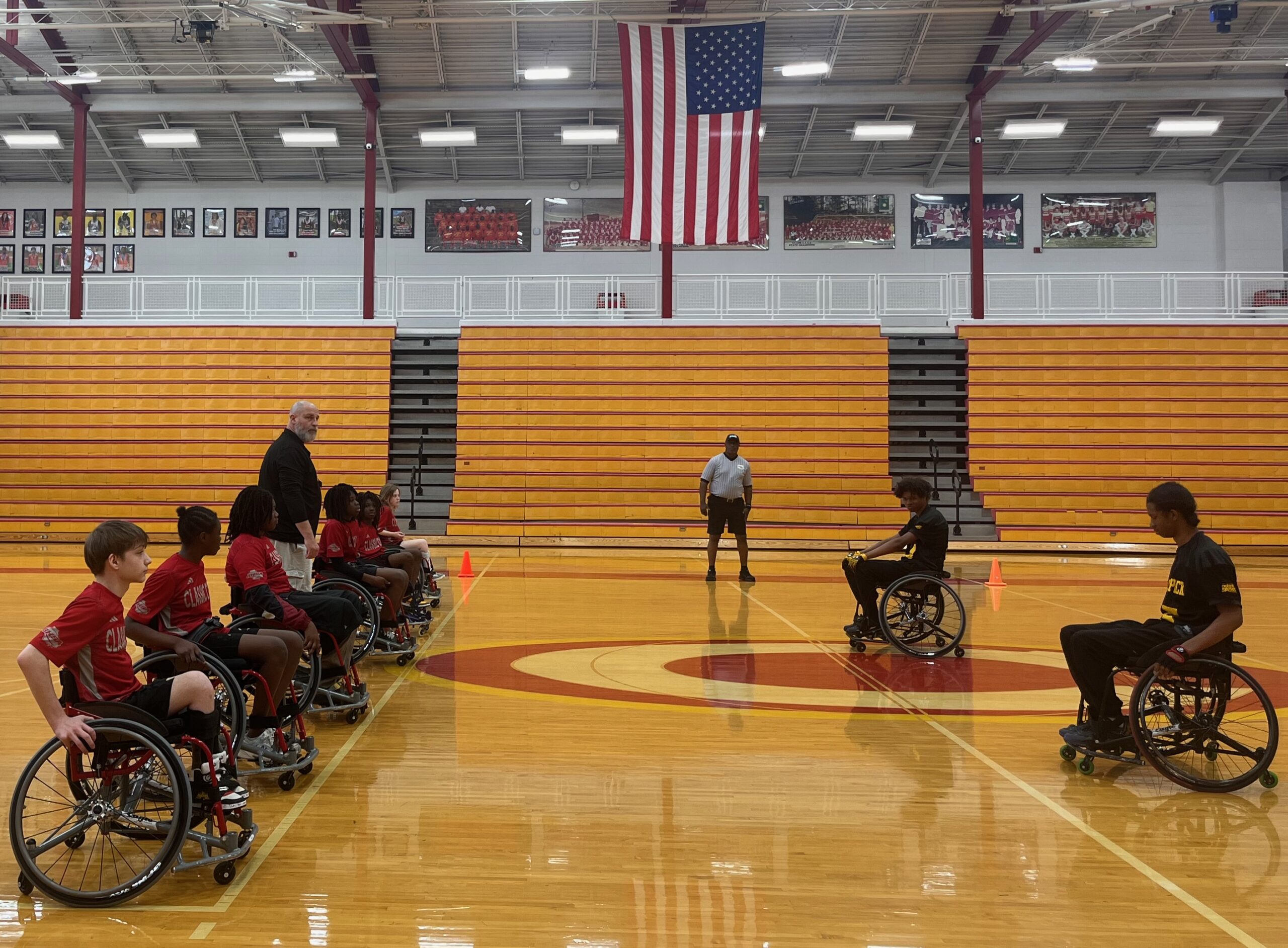
The whistle pierced the gymnasium at Clarke Central High School, and the Classic City Dawgs wheelchair football team broke from the line, pivoting into position.
AnukisSent Williams lofted a short pass to Lane Rogers, who pivoted and found space. Teammates marked defenders to hold the lane open, metal striking metal as the Atlanta Wolfpack closed in.
Rogers gripped his wheels and accelerated, weaving through traffic before rolling into the end zone. Cheers erupted as the Dawgs scored their first points of the football season.
Classic City, a wheelchair sports program, creates space for Athens-area students with disabilities to compete in organized team sports including handball in the fall, basketball in the winter and football in the spring. Founded in 2024, the program began with five players and a single coach and has grown into a multi-coach team serving students across Northeast Georgia, according to Clarke Central associate athletic director Chris Aiken.
In 2024, then-superintendent Robbie Hooker approached Aiken about applying for a grant through the American Association of Adapted Sports Programs. The $35,000 grant enabled the Dawgs to become a co-ed adaptive sports team open to any K-12 athlete in the region who qualifies, according to Aiken.
In the beginning, the program faced challenges. Many athletes were elementary school-aged, competing against established teams made up of older, high school players. After going winless in 2024-25, the Dawgs were undefeated in JV wheelchair basketball this year before falling to the Georgia Storm in the state championship on March 7.
That growth has carried across seasons, with the Dawgs going 1-5 in handball this fall and now sitting at 5-1 in the current football season, entering the playoffs tied for first in the JV bracket.
Despite these achievements, many potential athletes in the area still are not aware of the program, coaches said.
“Sometimes too, the lack of knowledge that these programs exist … that’s one of the barriers,” said volunteer coach Lorena Gonzalez Espitia.
For others, the hesitation comes from fear. Families of athletes with disabilities often worry about injury, even in controlled environments.
“What comes up a lot is that families are sometimes scared that their kid will get hurt, especially when they’re physically disabled,” Gonzalez Espitia said.
Nicole Kirk, an assistant professor in the department of kinesiology at the University of Georgia and co-director of the Pediatric and Motor Development Clinic, said participation in adaptive sports can help children develop a sense of identity and belonging, in which disability is not a limitation but a part of how they experience sport.
“I would say probably the biggest thing is just helping them find a sense of identity in which disability is not a bad thing,” Kirk said. “A wheelchair is just a piece of sports equipment. It’s the same as a pair of basketball shoes or a basketball itself.”
The Classic City Dawgs have already begun to show the impact of that approach.
At the start of the season, many athletes were hesitant to take on leadership roles. Now, practices often begin with players volunteering to lead warmups, calling out stretches and counting repetitions.
“At the beginning, a lot of them were pretty shy about it,” Gonzalez Espitia said. “Now somebody always wants to do it.”
For the athletes, connection is what matters most.
Just to get along with people that have what I have and show how there’s a lot of people that have it,” said Halyn Duncan, 11, a fourth-grade student at Malcom Bridge Middle School.
That mindset is what continues to drive the program forward.
“I mean, if you care about sports at all, I think you should care about more people being involved in sports,” Kirk said. “I believe that any time we can make the world bigger for more people, it’s a better world.”
Maya Koluder-Ramirez is a student in the undergraduate certificate program at the John Huland Carmical Sports Media Institute at UGA.