UGA Addresses On-Campus Food Waste with New Sustainability Initiatives

With five dining halls in every corner of campus, University of Georgia students have convenient access to food at a moment’s notice.
However, this comes at a cost. On-campus dining halls produce thousands of pounds of food waste each week.
The UGA Office of Sustainability is hoping to reduce waste with new technology tools such as Raccoon Eyes, a program that targets leftover food on plates in the dish return.
Why It’s Newsworthy: The University of Georgia is tackling food waste by implementing new ways to manage leftover food from dining halls on campus.Using AI to Prevent Waste
This new AI technology collects data on what foods are commonly wasted, through both user interface and behind-the-scenes analytics. First, when students return their plates, a screen will prompt them to answer a feedback question on the food that was served that day. A photo of each plate is taken as it moves through the dish return, which is then analyzed by AI software.
“We’re getting instant feedback data on ways to improve waste, like these recipes are popular, these aren’t,” said India Barfield, waste reduction coordinator for the UGA Office of Sustainability.
“We can start painting a picture of … how to design our menus better and to prevent the waste upstream versus after it’s already happened,” Barfield said.
According to Barfield, the dining halls saw a 21% decrease in food waste since the Raccoon Eyes program was first initiated in fall 2024.

A Career Dedicated to Sustainability
Barfield begin her career at the University of Georgia as managing chef of Joe Frank Harris Dining Commons. She gradually realized a need for better sustainability practices on campus until it became her job.
“They wrote it into my position that 30% of the time I would focus on sustainability for all of dining. So my last two years with dining, I was the sustainability coordinator for the whole department,” said Barfield.

Compost, Correct Sourcing, and Compassion For Others
In addition to the new technology, dining halls also use composting as a method to prevent wasting leftover food. Certain foods are saved and collected as compost instead of being thrown away. Thecompost is then picked up by the Athens-Clarke County Solid Waste Department and is sold back to community farmers to fertilize crops.
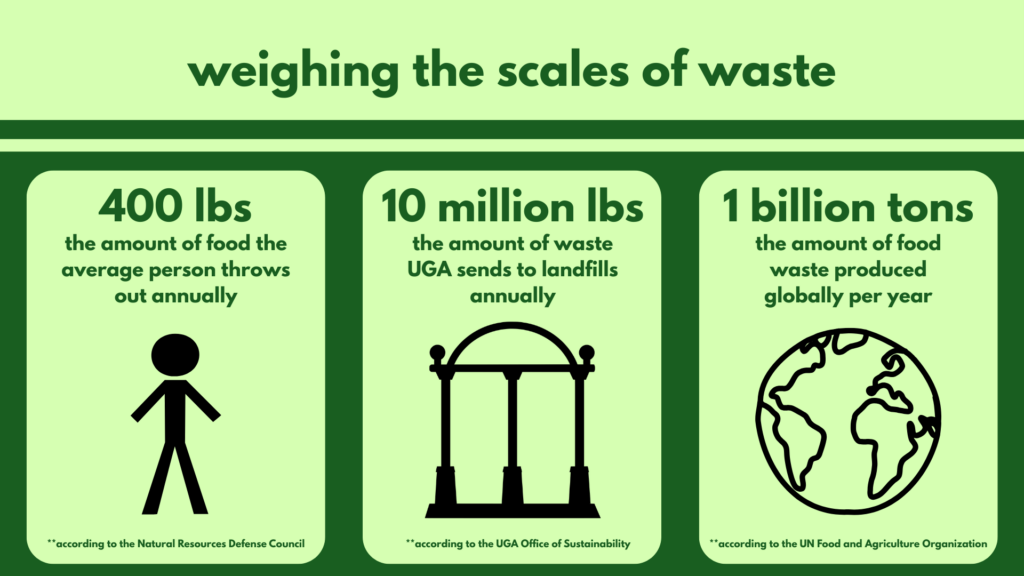
Food sustainability also ties in with where the food comes from, and how it is produced. This was one of Barfield’s many focuses while working for Dining Services.
“There’s still so many ways to tighten up efficiencies and just look at like the food system from a sustainable perspective,” Barfield said.
“The reality is we can only order so much fresh and local produce from a financial standpoint, when you’re talking about 30,000 meals a day. Yeah, we’d love to have all-organic, sustainable everything; that’s not in the budget,” Barfield added.
When prepared meals at the dining halls are left unserved, a percentage are donated to Full Plate, a food recovery program that provides meals for people facing poverty or homelessness in Athens-Clarke County.
With thousands of students enrolled in a meal plan, some food is going to be wasted. However, Barfield hopes sustainable systems such as Raccoon Eyes and composting could help ensure that UGA dining halls play a bigger part in reducing that waste.
Delaney Higgenbottom is a second-year student majoring in journalism and ecology.