By Evan Frilingos
The first time I passed the fruit stand on the street over from the hotel, its colorful array of hanging bananas, piles of mangos and so-called cherry tomatoes, which were larger than apples, stood out in the night like a shining carnival in a rural American town. I knew I needed to photograph it.
But the 10 women who sold fruit there felt like an army of soldiers who would turn down any request I made to take photos.
It’s been my experience that especially elderly women, like many at the stall, can be very apprehensive about photographs. But when I approached and introduced myself, Sarah, who speaks English, excitedly rallied the women for a photoshoot. It was as if they knew I was coming and had been anticipating getting photographed.
I went back twice afterwards. The highlight was when they all began dancing, singing and laughing with their printed photos in hand. I’ll never forget that moment, because in the same way the stand colored the darkness around it, this moment through my camera illuminated our shared humanity.
Six months from now, when Rwanda becomes a memory, I hope I will remember the power to see and stop time with others that the people I’ve met here seem to possess.
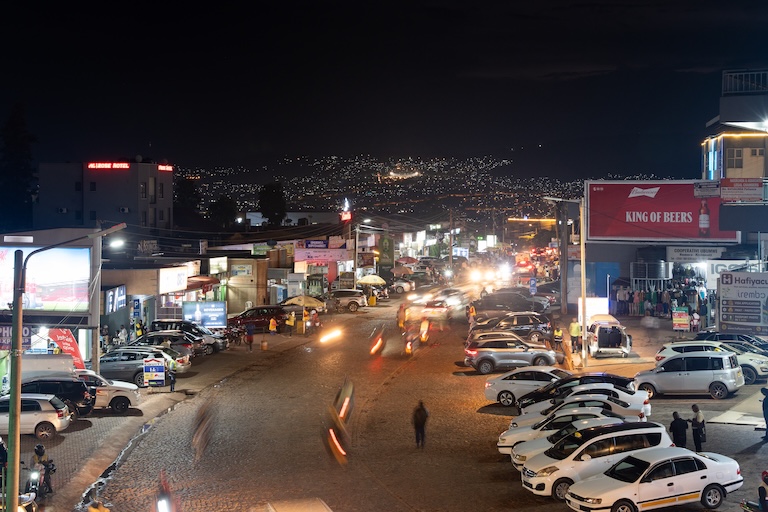
The fruit stand’s home is a bustling street that seems to have a life of its own. I felt its warm breath on my legs when walking past cars who have made the sidewalk their parking lot. I heard its voice reaching out with the wavelike cadence of motorbike hums.
It’s a typical street for Kigali, where glistening lights on surrounding hills replace stars, and the litter one might expect from a city is replaced by a similar spotlessness to what I saw in Tokyo.
There looks to be an abundance of light sources, but light from advertisement boards and vehicles existed on my periphery, as the nearest objects were still dim.
This is about 15 minutes before I first found the fruit stand on Thursday, May 21. The stand is about 30 yards down the street on the right.
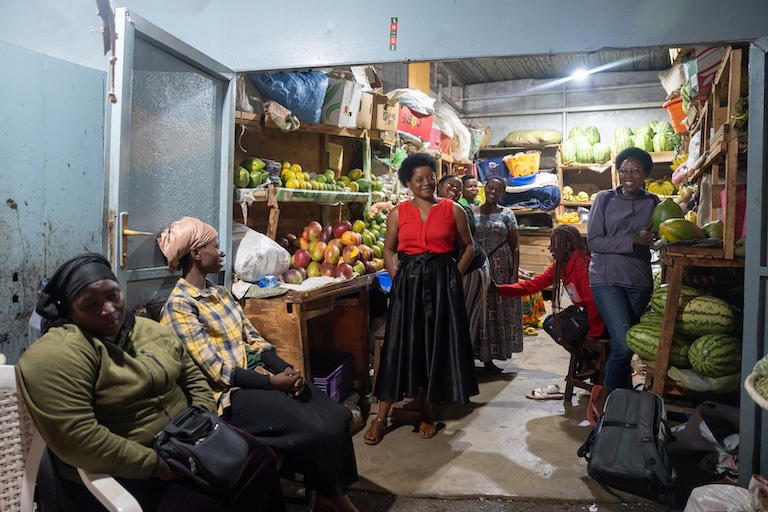
Finding the fruit stand was like walking into the only saloon in a tiny, close-knit Georgia town. All the women were gathered around talking, joking and paying little mind to the car doing a u-turn against traffic. But even though they didn’t know me and I was certainly an outsider to their circle, they soon opened up into a croissant shape to face and welcome me.
I was first glad my camera was there, because I was nervous and felt comfortable with it up to my eye, but it became clear that its better use would be to show the women photos of themselves in front of the fruits they sell.
They rushed to grab their fruits and beckoned me over. I sent them on WhatsApp the first time, but brought a printer the second time. We all watched in amazement as the printer pushed out each print in yellow, then pink, then full color ink. It’s a process I join with them in awe about, as I don’t understand how it works.
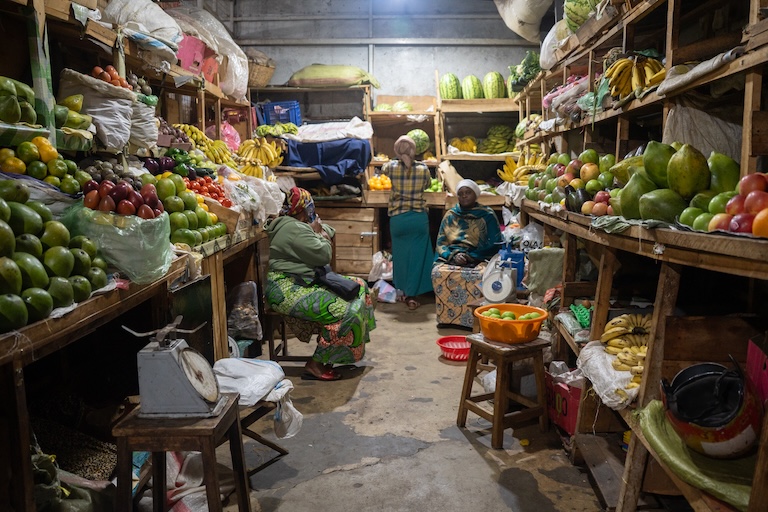
A raw, sweet, earthy scent slowly wraps around me as Sarah invites me inside. Despite the variety of fruits, boxes and sections, everything is neat and organized. I never saw a misplaced fruit.
The room is technically lit by a few dangling bulbs above, but I’m surrounded by glowing colorful orbs called mangos, apples, oranges, avocados and more. This creates a magical feeling, and I’m fulfilled by the vivaciousness of it.
They invited me in after I had shared my purpose to take photos. They wanted some of themselves with their fruit, but they also wanted to show me what they were doing and teach me how to communicate with them. It took what felt to me an excruciatingly long time to remember the difference between the phrases for “my name is” and “what’s your name,” but they only became more invested and smiled bigger after my failures.
It’s special to be invited into an intimate space like this because it exposes me to individuality and humanity that exists in small pockets of a larger space or story. They always invited me to return, which I did multiple times, and we waved at each other and said “friend!” when my bus passed by their stand.
I felt accepted and known in that space, and it’s the start of a relationship and trust I had only heard of from more mature photographers’ experiences.
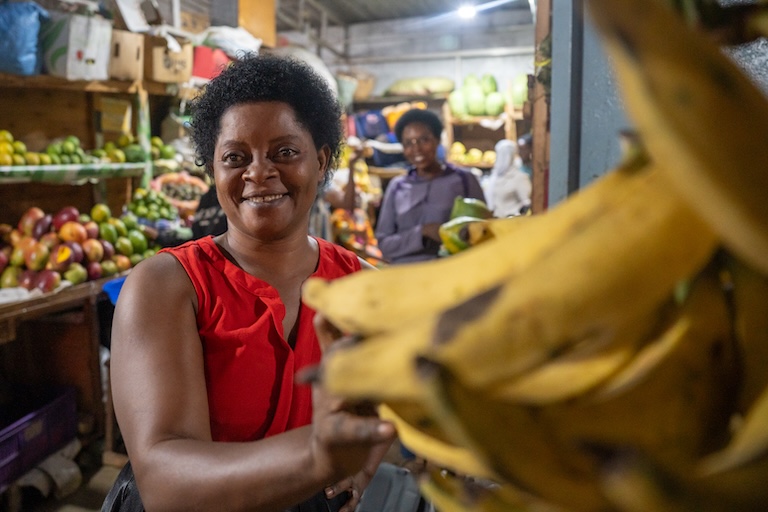
I often saw Rachel smiling and looking at me with the same expression my grandma does. She made me feel cared for, and was excited when I took interest in the hanging bananas outside.
She asked for a print of her with them, and I gave it to her while she was sitting in one of the white chairs to the side. She made sure I knew how to ask “amakuru,” which means “how are you” in Kinyarwanda.
The impromptu portrait shoot began during my second visit on Monday, May 25.
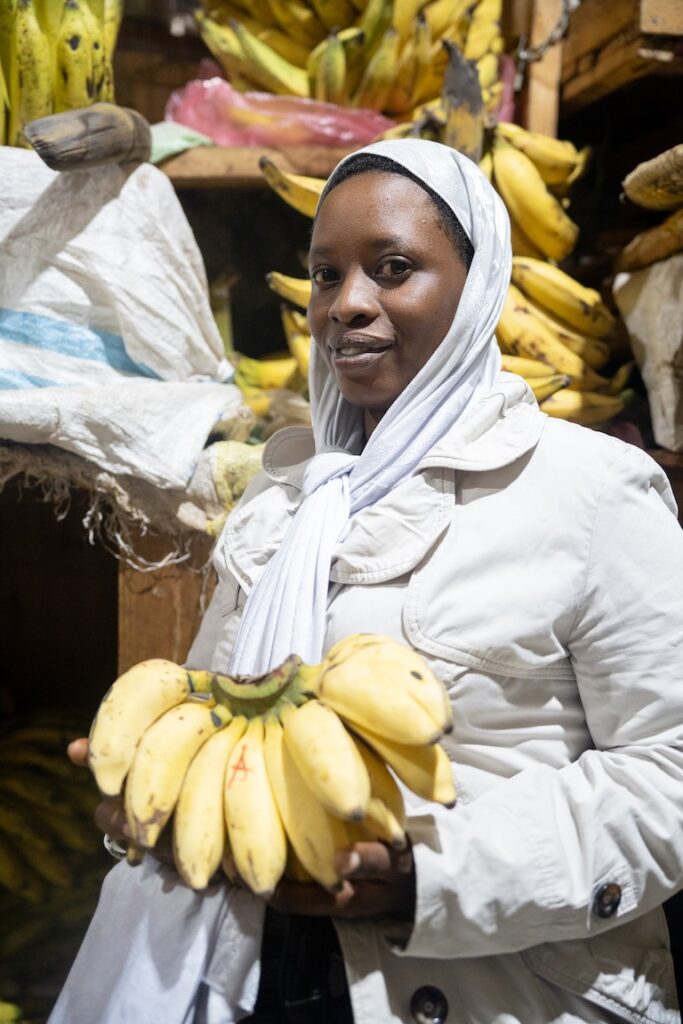
The mountain of bananas behind Valentine was a bright, ripe yellow every time I visited, and the small ones she’s holding became my favorite food in Rwanda.
I ate two for breakfast every day I was there. When I told her they were my favorite, she snuck a few into a bag for me and shot me a sly side-smile when I discovered them.
This brought me to an ethical dilemma. We’re taught in class not to take anything offered freely by subjects. The bananas weren’t given as a tool to manipulate my coverage, but as a gift that would be rude to decline. Accepting it and laughing about Valentine’s sneakiness built trust and a connection between us, both of which are valuable elements to a relationship.
I also didn’t feel like they were subjects of some objective, critical story where taking favors would make me write more positively. These women were collaborators and friends in this story, which wouldn’t exist without that relationship. It was one of the first ethical dilemmas I’ve faced, and it was helpful to think critically in the moment and make what I felt was the best judgment.
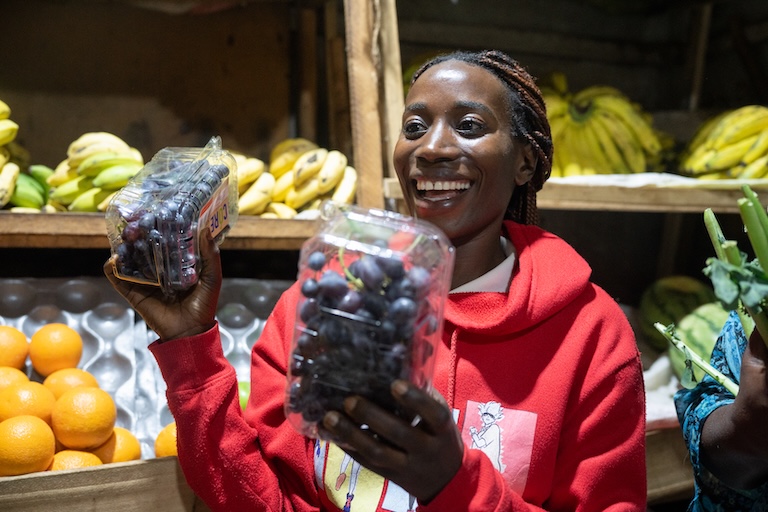
Ruwiz’s blueberry containers became her maracas for a moment when she danced and showed them off to her friend.
She started laughing when she saw the photo and told me she wanted it printed out. She said it was better than a posed one. Ruwiz was another of my main Kinyarwanda teachers at the stand, and she would bow over in laughter every couple minutes.
Evan Frilingos is a journalism major who took part in the Travel Journalism program in Rwanda in the summer of 2026.