


Reporter Annotations are meant to get to the how and why behind Newsource’s reporting through in-depth conversations with the reporters themselves. Have a listen or read the conversation below for how fourth-year journalism major Eva Duignan reported her first video story titled, “SNAP Benefit Cuts Leave Athens-Clarke Nonprofits Facing Sharp Rise in Demand.”
Hello. I am here with Eva Duignan. My name is Alex Perri, and I am a master’s student at the Grady College of Journalism and Mass Communications. Eva is also a fourth-year journalism student here at Grady, and we are discussing her story on Newsource titled, “SNAP Benefit Cuts Leave Athens-Clarke Nonprofits Facing Sharp Rise in Demand Welcome.” Let’s start by you just telling me about your story. What is kind of a quick summary of what you worked on and what you found while you were reporting on this?
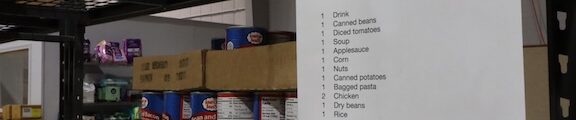
Eva Duignan: Basically, my story covered how nonprofits experienced level of demand increases due to the SNAP benefit cuts that were brought on from the government shutdown. So, I just wanted to take a national story and find it at a more local level and see how this federal cut was impacting our local community.
Alex Perri: I think you did a really good job of taking, I mean, it seemed like probably the biggest news story in the country around the time you’re reporting on it, and making it digestible and also really local. Was that daunting to you, taking such a big issue and distilling it down, or was that a challenge you really enjoyed? How was that for you?
Duignan: It was definitely daunting, and all of my interviews were really in-depth and long, and it was hard to decide kind of what path to take. But ultimately, I just wanted my story to be informative, and I didn’t want to go too in-depth. I just wanted to inform people about the level of need because a lot of people at UGA, I think, are not aware of the level of food insecurity in Athens.
Perri: I would also love to kind of back up and talk about your experience before reporting this story. I think the final cut was really professional, like I could see this on a broadcast news channel. How did you get to this point, and what were your experiences leading up.
Duignan: Well, thank you so much. This was actually my first ever video piece. I am in reporting (class) with Dr. (Jennifer) Duck, and it’s like a multimedia journalism class, and so we’ve been working our way up to the final project, which was this video. So, this is my first time working with Premiere Pro, and we’ve done audio before that, which kind of prepared us for this. But up until then, I’d really only done written. I did digital design instead of video journalism or photojournalism. But overall, I think, my time in Grady has kind of taught me how to approach a story, and it was really a fun challenge to be able to put it all into video and put it all together. Wow.
Perri: So, I’m impressed for this being your first video project. It was very polished at the end.
Duignan: Thank you.
Perri: You’re welcome. Do you have a preference for written or audio or broadcast journalism that you want to go into?
Duignan: I am really surprised how much I’ve been liking multimedia journalism this year. I kind of I went in to, I’m actually pre-law, so I’m not completely sure that I’m going to end up on a journalism path. But I had considered journalism as a path, and I’d only ever considered written. But now that I’ve gotten into the multimedia aspects of it and seeing how you can approach a story in so many different ways, it’s definitely opened my eyes a lot, and I would definitely be open to doing multimedia as well.
Perri: I mainly am a print or written journalist, but one of the things I appreciated about your story was, there was a wide variety of sources, but there were a lot of interesting details, visually that you included. I thought there was a lot of great broll of people shopping or people at the distribution sites. But then there were a couple times when Geoff Rushing from City of Refuge, he was talking about how difficult these SNAP benefit cuts were going to be around Christmas time, and you had shots of Christmas balloons in the grocery store. What was your thought process behind piecing all these details together? It seemed like it was kind of creative for being a hard news story.
Duignan: I think the holiday part was really important to include. It was hard. He had so many quotable quotes, just because he has been experiencing this level of increase. But I think showing the holiday part kind of made it more understandable, I guess, and showing the holiday balloons and the Christmas trees and things like that, I guess, makes it more personal, because the holidays are something we all enjoy. And to put that with such a sad story, I guess kind of puts things into perspective in a way. But yeah, I did definitely have to be creative with broll. I wanted to consider the emotional elements as well, but I wanted to make sure that it was also like an interesting piece to watch and kept people’s attention.
Perri: I think you accomplished that. Can you tell me about your approach to this story? You mentioned earlier, before we started recording, that you had an idea going into it, and then you kind of pivoted. Talk me through that process.
Duignan: So I went into the story, kind of hoping to get personal stories from people that were impacted by the cuts. And I went to the distribution site, and I did talk to people, and I had mentioned to Geoff Rushing, who’s the founder City of Refuge, that I wanted to get people’s personal stories. But I just kind of felt when I was talking to them, they were hesitant to talk to me. And I kind of realized this is like a situation that I kind of needed to handle with care. And I ultimately decided that maybe shifting to focus on the story from the nonprofits angle might be more moral. I guess I just wanted to make sure that nobody felt uncomfortable in a situation where they’re already struggling. And a lot of people at the distribution sites were also there with their kids, or I had some people come up to me and asked to not be in any of my broll shots because they or someone they were with is undocumented. There were a lot of things that I just didn’t consider before. So, I ultimately just ended up shifting. And I think the shift was completely fine, because it still got the story at a local level, and you still see the impact on a local level, because these nonprofits were seeing the demand rise. So yeah, that was definitely a challenge, but I think ultimately, I still got the full story and got my intended goal across.
Perri: I think Geoff, like you said, he had a lot of great quotes, and he seemed to be a great source, especially, I think his opening quote he’s talking about this has become a full-blown crisis. But I want to kind of ask you, and this is, I think, like an ethical problem that I have really kind of questioned or wrestled with, and I think other journalists probably have. Did you talk about this with your professors, the balance between wanting to present people’s stories? A lot of time, the most powerful way to present a story is to hear first-person accounts, while also, like you said, this is a subject matter that’s very sensitive, and wanting to protect people that are going through a hard time, that’s such a difficult balance, and it’s something that’s hard to, I think, nail. But did you talk about that with your professors or have those conversations in class?
Duignan: Yeah, I know. My professor, Dr. Duck, I kind of mentioned to her that I was like, hesitant to go up to people, just because I wanted to be sensitive. And she always encourages us to get the first-person account. You know, it makes a story a lot more meaningful when you’re talking to someone that’s actually experiencing what you’re talking about, rather than like the policy makers or things like that. So, she encouraged me to try to get first-person accounts. And I think just this being my first time approaching such an emotional story probably made me more hesitant as well. And after my first three interviews, where the people were also hesitant, I just ultimately decided to shift. But if I were to do it again, I think I would try to still get a first-person account. I think that maybe that is what my story is missing, in a way. But definitely there’s ethical concerns to consider because, you know, you don’t want to, just like, put someone’s life on blast when it’s already really difficult for them.
Perri: That makes sense, and that’s hard, especially when you’re going into a public place, which I’m not sure if these food distributions are considered like public places, but, you know, certainly grocery stores and things like that, where it is legal to take pictures of people’s faces. But at the same time, it’s like, you have to be sensitive.
Duignan: Absolutely.
Perri: I want to ask you, you know, this is difficult subject matter. And there was a story that you included toward the end of end of your piece that talks about a neighbor coming to City of Refuge on a non-distribution day, and they were begging for food for an 8-year-old child and their grandma. Tell me about what it was like getting that information, collecting it and then choosing on how to report it.
Duignan: I think I definitely underestimated the emotional toll that this story would take. I spent two hours at the distribution site the day of the distribution, and I was there the day before, while they were packing bags. And just on the record, talking to people, but also just like hearing other stories, just chatting with people around the distribution site, really was heartbreaking to witness and hear just how hard this was hitting. And the emotional part that I felt, I realized that was the important part of my story, so I wanted to make sure I included an actual narrative that was emotional to get the point across to audiences. But yeah, I definitely didn’t expect just how much it would affect me emotionally. The day of the distribution, they were handing out cakes to people for children’s birthdays and diapers to mothers. So, it was definitely emotional.
Perri: Was that eye opening for you? Were you aware of the magnitude of this problem before going to these sites?
Duignan: Yeah. I volunteer at Clarke County School District schools, and so I definitely am. The reason that the program I am a part of started is because of the low levels of reading and the high poverty levels in Athens. So I was aware of the level of need and food insecurity in Athens, and that is why I wanted to report on something like this because I knew that the SNAP and cuts would be impacting the Athens area, but still to witness and hear these stories firsthand was still shocking.
Perri: Yeah, it was, and it was, it came across, I think, in the final piece. But I want to ask you, knowing that it impacted you so emotionally, what did you most want to come across when someone was watching it? Like, what did you want people to feel when they were seeing the final product?
Duignan: I really like journalism for its power to inform people. So, I really wanted to, like, educate people on these impact cuts, because it was something that was just like really being talked about in the media a lot. And I think when it’s like such a huge national story, it can be hard to understand, understand that, yes, this is a national story, but it’s also a local story. So, I wanted to show just that these policy changes and these national level things do have a local level effect. And I’m also really interested in unique solutions journalism, so I hoped that maybe in educating people, it would also push people to make a change or go out and help.
Perri: What were some of the biggest lessons you learned while reporting this? Maybe not even necessarily when it comes to, like, your civic duty as just a citizen of Athens, but even as a journalist, what are you taking forward after working on something like this?
Duignan: That’s a good question. I think, I think it made me a lot less scared. Just to you know, Can I record this? Do you mind if I take a video of this? Just, I realized sometimes that awkward interaction or that nervousness is sometimes worth it in the end to get the shot and get the story. So that was definitely a lesson that I learned. I also, I think just the emotional level of this story was something I’d never experienced before, so that just taught me a lot in general, moving forward.
Perri: When it is a subject like this, you are really motivated, I think, to kind of push past those that you have just on yourself feeling awkward, and they can really push you in improving your skills. To wrap up, I kind of love to end on maybe a lighter note and want to ask you what your hopes are for the future. What kind of career aspirations do you have? What’s in store next for you?
Duignan: That is also a very good question. I am currently kind of trying to figure it out. I think this whole semester has really been eye opening because, as I mentioned before, I was on the pre-law track, and I wasn’t fully considering journalism as a career. But this semester has kind of made me reconsider. So, I’m definitely applying to multimedia journalism roles and things like that, just because the story especially kind of opened my eyes again to why I chose journalism as a major, so I’m excited to see where that takes me.
Alex Perri is a graduate student in the journalism program at the Grady College of Journalism and Mass Communication.

Show Comments (0)