Tech-Driven Tourism: How AI, Social Media Affect Travel in Hawai’i

These three stories, by Caroline Feagin, Annabelle Foley and Clarice Henry, were created as part of the Travel Journalism in Hawaii program through the Grady College of Journalism and Mass Communication.
Hawaiʻi’s Next Tourism Debate Isn’t About Hotels — It’s About Algorithms
By Caroline Feagin
At sunrise in Waikīkī, the shoreline is already quietly in motion. Hundreds of tourists scattered throughout tall, expensive hotels prepare for the day ahead by booking tours, planning beach trips and making dinner reservations — all through a SMART tourism app that helps inform them of weather concerns, “know before you go” plans and cultural awareness guidelines.
Artificial intelligence (AI) has quickly taken over the world. From students using generative AI to complete their math homework to businesses relying on machine learning to improve efficiency, AI has become an unavoidable part of human life.
While not a mainstay of Hawaiian tourism yet, a research study from the Hawai’i Tourism Authority on the implementation of the app could make this reality come true.
A new AI pilot program designed to introduce organizations to practical, ethical and responsible uses of the technology was recently introduced by the the City and County of Honolulu’s Office of Economic Revitalization (OER), in partnership with Māpunawai and Skilled Tomorrow. Along with that, Honolulu Mayor Rick Blangiardi has emphasized the use of AI tools to promote affordable housing in Hawai’i in his state of the city address.
It is hard to miss how commonplace AI has become in tourism in Hawai’i. AI-generated itineraries tell visitors where to go on TikTok, telling them not to miss some of the most common activities done in Hawai’i, like exploring the shores of Waikīkī Beach, quietly walking through the large and elegant ʻIolani Palace and snorkeling through the crystal blue waters of Hanauma Bay Nature Preserve. Local AI guides even claim to show “hidden gems, iconic beaches, sacred trails and cultural landmarks across every Hawaiian island.”
Sukhwa Hong, an associate professor in the college of business and economics at the University of Hawai’i Hilo, is exploring how to use AI to understand visitor experiences in Hawai’i through smaller AI agents that have an expertise in a particular area of tourism, like food or hospitality.
These smaller agents read reviews regarding food or hospitality or other topics related to tourism, figure out what it is asking for and send it to the AI agent that knows that topic the best.
Hong sees a real opportunity for AI to help economically support the state of Hawai’i, with its limited resources and small size. As AI is able to quickly compile and interpret data at rates that far exceed the abilities of humans, humans are then able to interpret data about the emotions of tourists and locals quicker, prompting faster changes and further improvements to tourist attractions.
Commercial tourism isn’t the only thing AI is being used for.
Hong used AI to conduct research in Thailand that analyzed how visitors responded to elephant sanctuaries compared to traditional zoos, finding that ethical and environmentally friendly tourism led to more meaningful experiences. He hopes to bring what he learned from Thailand back to Hawai’i to create a better experience for visitors and locals alike.
“People, when they think of AI, they think about these giant tech companies with a lot of resources,” Hong said. “But it’s not always the case. If you use it wisely, like us here in the state of Hawai’i, AI could be a tool that could help us.”
Locals agree with that sentiment as well, but have some reservations on fully embracing it.
“I think AI has opportunities in a number of different spaces,” said Rebecca Soon, president of Solutions Pacific and Ward Research and a native Hawaiian. “We [can] allow people to have more time available for human-centric engagement, and that’s where I see the greatest opportunity with AI.”
Soon has done immense work in regenerative tourism — a type of tourism that prioritizes giving back to communities and educating tourists on the cultural and social practices of Native Hawaiians.
One of the fundamental goals of regenerative tourism is to make the relationship between locals and tourists more equal. Instead of tourists taking and locals giving, the relationship can be reversed, with people volunteering for beach clean-ups or educating themselves at museums about the culture of native Hawaiians.
She sees AI as a means to promote regenerative tourism, though she said human intervention is a necessity for “quality control.” AI itineraries, for example, are an ever-more common way tourists use AI to find places to go. Soon finds these to be helpful, but ultimately wants people to be involved from the beginning.
“Humans have to be the ones to still look at it and say, ‘Okay, no, this is not a good place to go to, because the traffic,’ or ‘because it’s sacred,’ or ‘because there’s this community trying to revamp what it’s doing,’” Soon said.

But some people remain concerned. Social media users have criticized AI-generated itineraries from other users, asking people not to use it and saying that “it uses 10x as much energy as a standard search.”
Soon acknowledges those environmental concerns, but said most of them have not affected Hawai’i as much as states in the mainland.
Despite reservations from some, Soon and Wong both see the benefits of AI for promoting more sustainable tourism. Wong points to AI as a source for tourists to gain more cultural awareness and knowledge to help avoid incidents like the recent case in which a tourist threw rocks at an endangered monk seal.
Soon also hopes to see AI being used as a storytelling tool to tell the stories of Hawai’i’s people and the data stories that inform their standard of living, like those of their healthcare, land and water resources.
“I hope [the future of AI] looks like AI helping to tell the stories of Hawai’i’s people,” Soon said. “Through telling those stories we can attract the kind of people that want to help Hawai’i be a stronger and more vibrant place for the people that live here, that they can enjoy Hawai’i, that they can learn about Hawai’i, but they can ultimately leave Hawai’i stronger and better than when they came.
“I hope that AI can be a partner in that.”
How Viral Travel Posts Transform Hawai’i Tourism
By Annabelle Foley
Leonard’s Bakery sits outside the bustling tourism bubble of beachfront Waikīkī, yet crowds of tourists wrap around the vibrant building each morning. The scent of sweet malasadas and sound of excited chatter weave through the line. Customers regularly pull out their phones to take photos of the shop — and of course, a photo must be taken of the pastries before they dare to take a bite.
Social media has transformed the way tourists experience Hawaiʻi, sending waves of visitors toward restaurants, hikes and beaches that once relied largely on word-of-mouth. Viral posts shape itineraries and trips. Expedia found that 73% of travelers say influencer recommendations have shaped their booking decisions. Tourists no longer plan trips based on guidebooks or maps; instead, their travels are driven by what they see on their feed.

The tension between tourism and local culture in Hawai’i long predates Tiktok or Instagram. However, the ease of access to the Internet further complicates an already tumultuous conflict. The economic research organization at the University of Hawai’i found that in spring 2024, only 56% of Hawai’i residents agreed that tourism has brought more benefits than problems — down sharply from over 70% in the early 2000s.
“Years ago, there would be secret beaches or secret hiking trails, but because now we have GPS, people could find places where before you would have to use a paper map,” said Jerome Agrusa, a tourism industry professor at the University of Hawai’i at Manoa. “People could go to places where they never went before, and they could go to places where they maybe shouldn’t go.”
Maci Carney, an O’ahu resident of six years and a travel content creator, said tourists seek out secret spots because of the perceived value of a locally beloved location. She believes content creators have a responsibility to respect the locals of areas they travel.
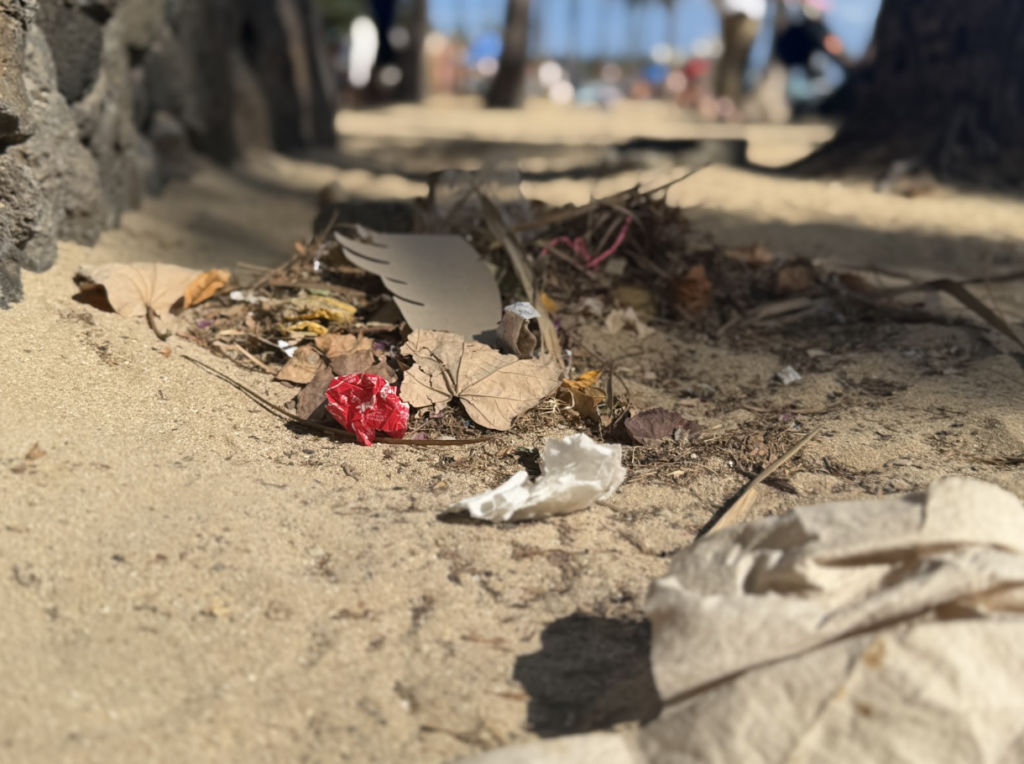
“I often see a lot of people on TikTok posting more like secret beaches or secret spots, and that’s fine in my opinion, but what’s not OK is geotagging that location,” Carney said. “It brings in a lot more traffic to that area, and in turn people will leave their rubbish on the beach, they’ll not take care of it, and what might just be like an actual secret local spot for people that live here … becomes completely overrun by tourists.”
This issue is especially apparent in O’ahu, as local residential communities are situated directly around popular tourist spots.
“Because we’re a small island, and a lot of the hikes, or the beach parks, you have communities nestled up against it,” said Catherine Orlans, the manager of communications and content deliverance for the O’ahu Visitors Bureau. “One challenge was the Stairway to Heaven hike that’s popular on social media. A lot of people were parking in the residential neighborhoods, and there’s no infrastructure in this area, so they’re using their garden hose to drink water after their hike and using the bathroom in their yard.”
Orlans reiterated the importance of not geotagging a local spot. She also said the attention social media can bring to a hike or beach can be directed toward island businesses. These businesses have also changed their marketing in the digital age, aiming to have “Instagramable” photo ops and trying to be featured in vlogs or travel videos.
Vincent Lassoff, the owner of Pit Stop Hawai’i Food Truck in Waikīkī, saw firsthand the impact that a simple travel post could have on a small business.
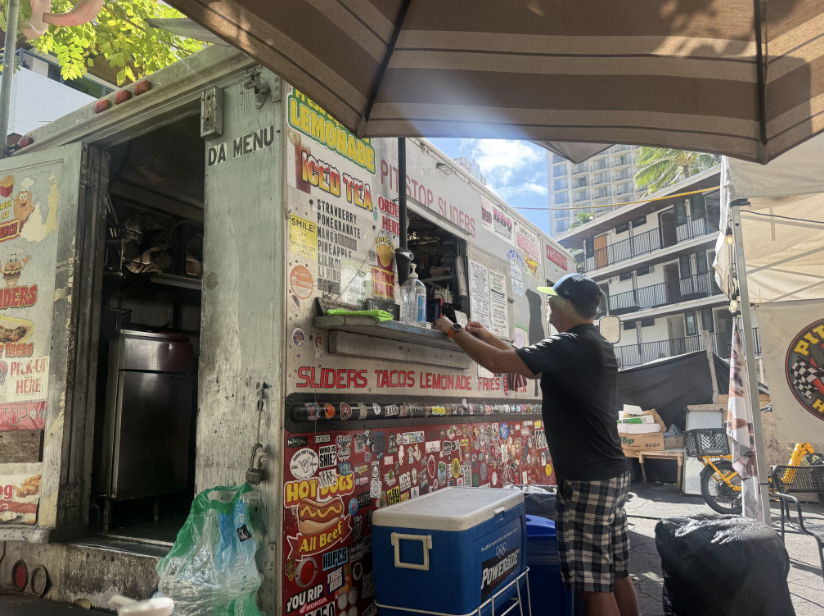
Pit Stop has the charm of a classic “hidden gem.” Situated in an alley a few blocks from Waikīkī Beach, the taco truck fills the small lot with savory, enticing aromas. Lassoff himself brings trays of freshly cooked burgers, tacos and sandwiches to customers sitting under umbrellas at quaint picnic tables. The spot feels isolated from the bustle of the road, resulting in a cozy, immersive dining experience.
“There was a [Korean] influencer who came by our place when we first opened,” Lassoff said. “Him and his girlfriend got some food and took it back to their hotel room. They took a bunch of pictures of our food, and I’ve seen those pictures from this guy more times than I can count. Almost 50% of the people who come here are Korean. It’s crazy. It’s wild. It started there with that guy.”
Pit Stop is featured in hundreds of videos on Tiktok and Instagram. One recent TikTok by local influencer AskDeeWaikiki resulted in an influx of customers, according to Lassoff. The attention drawn to Pit Stop via social media has directly impacted its business practices.
“We were doing around 2,000 sales every day, and now we’re doing 3,000 to 4,000 in sales every day,” Lassoff said.
It’s almost doubled our business. So I’ve had to bring on more staff. Labor-wise, it changed the team a lot.”
Agrusa said this same online attention could impact the charm that made a spot special in the first place.
“A local resident [now] has to wait for his coffee, where before he’d come in, he’d talk to the person behind the counter, and say, ‘How was your day?’ We call it talk story here,” Agrusa said. “Now the person has no time to talk story, because there’s 20 people behind them, and that difference, that unique charm has now changed.”
In a constantly evolving digital landscape, the tourism industry is faced with new challenges and tensions.
“It’s always great to learn about the local culture, learn how to respect the local culture, to learn about the history of it and understand that there are cultural differences around the world,” Carney said. “Always just understand that things can be different, and that’s okay. It doesn’t mean they’re wrong.”
From For You Page to Reality: Rethinking Ethical Tourism in Hawai’i
By Clarice Henry
Weeks before I landed in Hawai’i, my For You page was flooded with videos of restaurants, nightlife scenes and thrift stores. I wrapped myself in my covers and continued to scroll. Like every TikTok video, each one began with a clickbait title: “Places you will never find,” when in fact it is a place you easily could.
Even more interesting is that they all seemed to have one common denominator: a caption touting “non-touristy areas” along with comments like “respect the land.”

As tourism continues to rise in Hawai’i, it’s clear that the social media story of the islands doesn’t always match the reality. Hawai’i hosted more than 9.6 million people in 2025, according to the Department of Business, Economic Development and Tourism. Airbnb and hotels are the two main methods that are used to provide a once-in-a-lifetime experience and show the unique culture of Hawai’i. However, this demand has continued to impact local Hawaiians with ongoing concerns about housing availability for the average income. In 2023 alone, roughly 6,234 Hawai’i-born residents left the state in search of affordable housing, with a significant portion falling within the 18 to 24 age demographic.
Today, countless tourists stay within the neighborhood of Waikiki’s familiar rhythm, an endless stretch of ABC Stores and crowded sidewalks. Yet, beneath the glow of luxury storefronts and hotel balconies are reminders of the people who call Hawai’i home.
Travelers like Line Graversen, a San Francisco study abroad student and Denmark native, said she did not have any prior knowledge on the ongoing housing crisis in Hawai’i.

“I had actually not thought about [the housing crisis],” Graversen said. “My friend had stayed at this hotel with her family before and said they loved it, so I just trusted that recommendation and wanted to vacation somewhere nice.”
In Hawai’i, short-term rentals, such as Airbnbs, are regulated under strict housing laws intended to minimize rising residential costs and prevent locals from being pushed out of their homes. Short-term rentals are only legal in certain resort-zoned neighborhoods or with proper permits approved by the Honolulu Department of Planning and Permitting.
Despite this, some local social media creators argue legal and illegal vacation rentals continue to harm Hawai’i’s housing market and long-term sustainability for people in the area. Others argue that there is no complete ethical way to visit Hawai’i that contributes to the economic profitability of local Hawaiian and indigenous groups.
TikTok creator Lily Hi’ilani said tourism further intensifies the housing displacement due to the government’s lack of communication within the community.
“People often forget that we are tiny islands in the middle of the Pacific Ocean with finite resources,” Hi’ilani said. ”Now add on thousands of tourists daily, hundreds of thousands a month, and millions a year. This causes massive pressure on housing, water, energy, roads, beaches, waste systems and emergency services.
It’s not like we can scale up and go to the next island over. That’s like a five-hour plane ride.”

Kamohai and Tristyn Kalama, Home & Garden Television personalities and Airbnb owners from the hit-show Renovation Aloha, recently faced fines in January 2026 after illegally renting out properties for Airbnb without proper permits to approve of a less than 30-minimum day occupancy. According to the Honolulu Civil Beat, the couple earned more than $1.3 million from their short-term rental on Kamehameha Highway that also received a building violation notice.
I arrived in Hawai’i expecting curated recommendations and aesthetic cafes pulled directly from social media. Beyond the tourist attractions, I was faced with a deeper reality shaped by native history and its efforts for environmental preservation.
According to the Hospitality Academy, ethical tourism refers to travel practices that reduce environmental impact and contribute to local community welfare and culture. It also includes considerations such as wildlife protection and the support of local businesses through understanding the cultural significance of the islands, such as the ecological importance of sea turtles. Across O’ahu, locally owned restaurants and markets continue to preserve traditional cuisine and attract visitors seeking alternatives to chain restaurants.

“When we travel, we try to find a day to commit to culture, just to go and make sure that we are putting money back into the local economy and go to find areas that are off the beaten path,” said Bianca Kwentua, a traveler from Louisiana.

Some tourists leave with a new perspective and a deeper understanding of Hawaiian culture rather than a fresh new pair of heels. Still, the future of Hawai’i may depend on a stronger comprehension of ecotourism and greater awareness of the 27 islands that lie within the Pacific Ocean.