To this River Community, Hurricane Helene Dealt Existential Blow

CORRECTION & CLARIFICATION: This article has been updated for accuracy regarding the Narrows’ features and typos. The corrections have been made in the article below. The article has also been updated for clarity regarding the official founding of Bright Shadow.
It’s the rain that makes this place so. The rain forms eternal rainbows in the mist below the waterfalls. The rain grew the dense, green forests that the white man clear-cut to stubs a century ago. And it’s the rain that supplies the water for the beer that inebriates the visiting bachelors and bachelorettes in downtown Asheville.
About 30 miles south of Asheville lies the Green River Gamelands. Paddlers from across the Southeast are gearing up for the best day of the year — the Green Race. The rain has brought them here today.
It’s Friday, Oct. 31, 2025, Halloween morning, down in the gorge, and a day before the biggest paddling holiday of the year. The tulip poplars and birches line the riverbank like a blazing yellow wall.
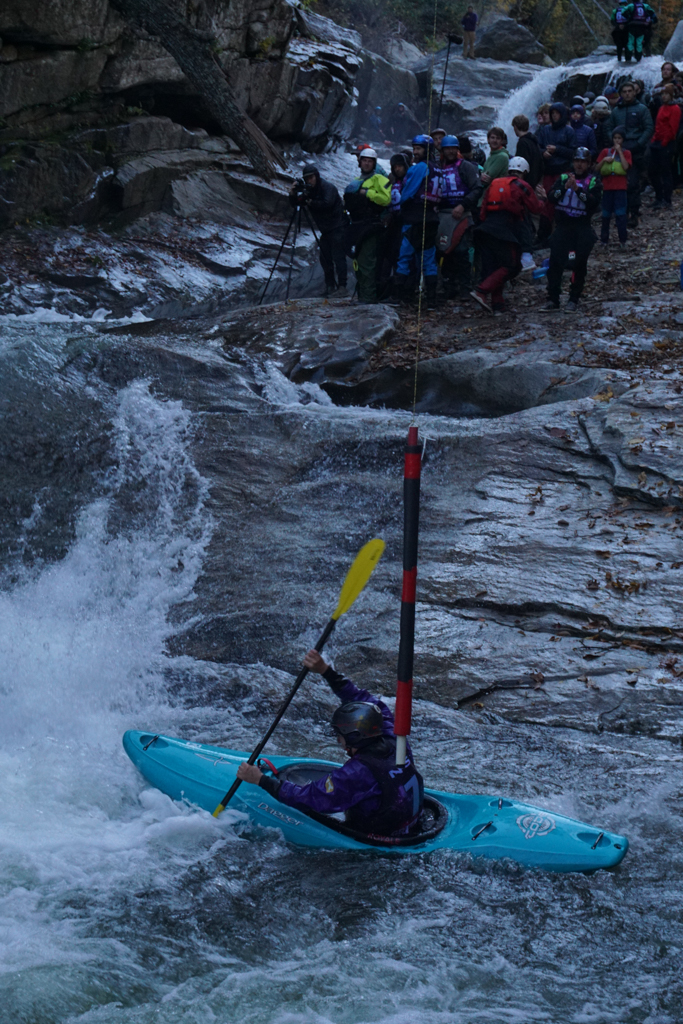
The river is raging from a solid rain earlier in the week. Before that, the region hadn’t seen a heavy shower in months.
Along the Green, paddler, entrepreneur and bulldozing optimist John Grace limps up and down the exposed rock that forms its banks. Grace, his wife Chelsea and friend Jason Hale form the official Green Race organizing trio, and they’ve been hellbent on making this race happen one way or another since last year’s race was canceled in the wake of Hurricane Helene.
Until now, few thought it was possible.
Yesterday, on Thursday night, John and Chelsea wore matching Where’s Waldo costumes to the race’s welcome party and costume contest. Today, Grace showed up at the rendezvous point haggard, either hungover from the Halloween festivities or weary from the months’ worth of items on his to-do list he’s been feverishly ticking off since he threw up the green flag for the upcoming race just days ago.
Grace just turned 50, but his shaggy hair and brand of kowabunga cool give him an air of perpetual youth. He hurt his knee packing gear recently, and despite this, he and his team have been hiking in and out of the near-vertical canyon with massive loads of equipment for days to prepare for the race.
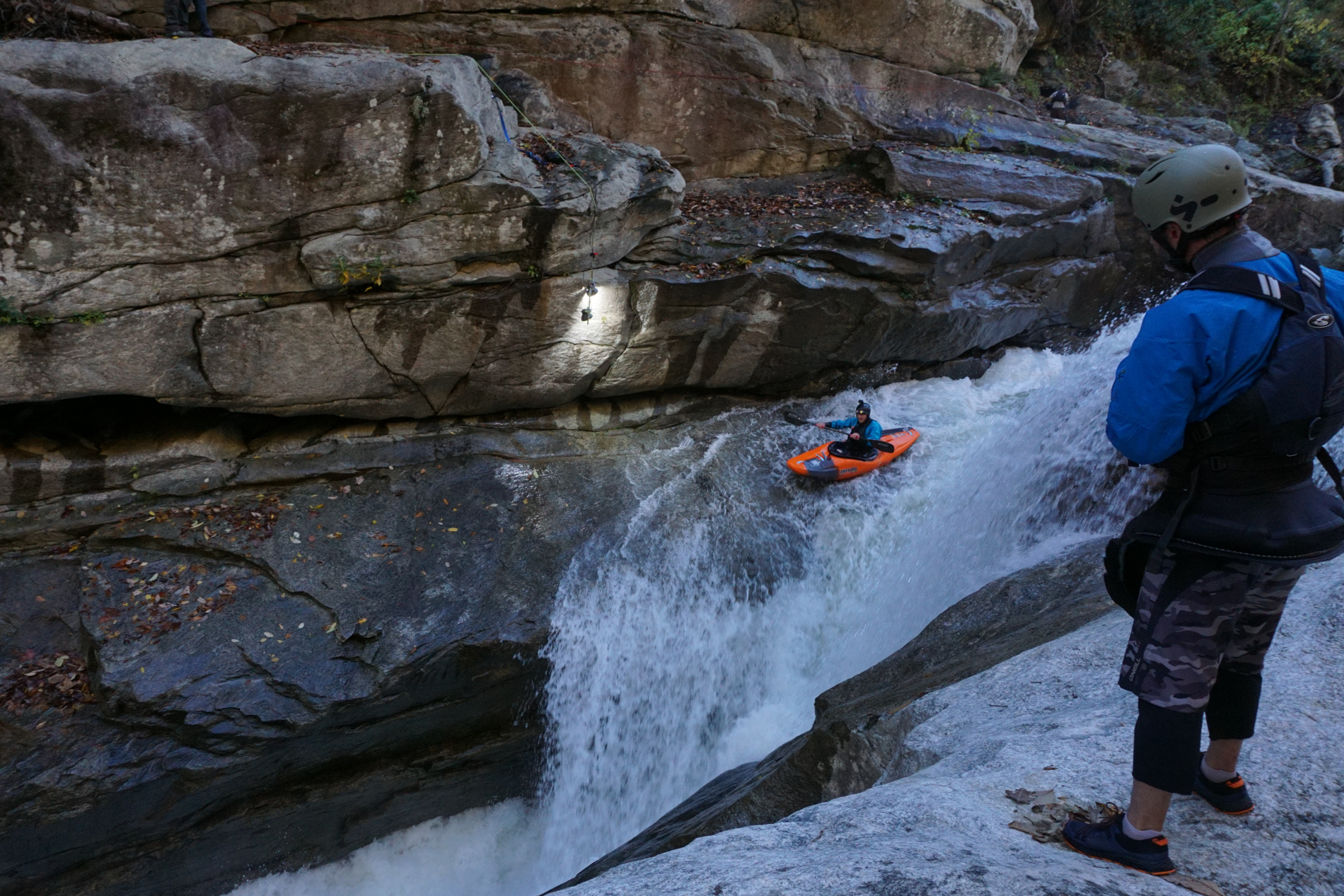
On this section of the river, known as The Narrows, the Green squeezes through the rocky slot of a canyon and drops 300 feet in one mile. It’s steep, burly and roiling with class V rapids.
Race day is tomorrow, Saturday, and there’s much to do. After the gnarly hike in, which involves scrambling down a ravine using ropes to pseudo-rappel yourself to the river, Grace speeds up the riverbank to help finish constructing the delicate web of audiovisual cables across the gorge that, tomorrow, he will use to livestream the race. Before the COVID-19 pandemic, he says he was as close as he had ever been to making paddling the premier entertainment extreme sport in the country. He just wants to make all his friends famous, he says.
In the early aughts, he gave that dream the old college try. He joined a video production company called Lunch Video Magazine. This was before YouTube had the capacity to stream high-quality videos, and the company used an ingenious by-mail subscription model to spread their tales of gnarly, globetrotting first descents and jungle explorations across time and space. It was a proto-Netflix, and the magazine and its stars (Grace among them) were in part responsible for the massive evolution of the sport of paddling. These videos were to young paddlers what “Slasher“ was to aspiring skaters, or “The Endless Summer” was to ’60s-era surfers. Between the late ’80s and mid-2000s, the sport exploded. Gear technology skyrocketed, and so did the technical skills of the athletes using it. Stoke, as it turned out, was an exponential feedback loop.
Though his globe-trotting days are not fully over, Grace focuses much of his current-day attention on the Green Race and his production company, Amongst It, which broadcasts the Green Race from deep inside the remote, cell service-less canyon. He sells tickets to the livestream and replay broadcast for $35-$45, helping bring the event, which he calls “The Greatest Show in All of Sports,” to the masses who can’t travel to North Carolina or can’t physically muster the wild hike in.
On the river, Grace works to connect audiovisual cables to their various pieces of equipment. He has to use walkie-talkies to communicate with his team over the noise of the raging water at the crux of the Narrows. One wrong step on the slippery Henderson gneiss, and any member of his production crew could surely plunge to their death. Somehow, though, good paddlers have an almost supernatural surefootedness on even the most treacherous of rivers. This is the Narrows’s crescendo — the big kahuna. According to legend, here, they stand at the threshold of a violent beast.
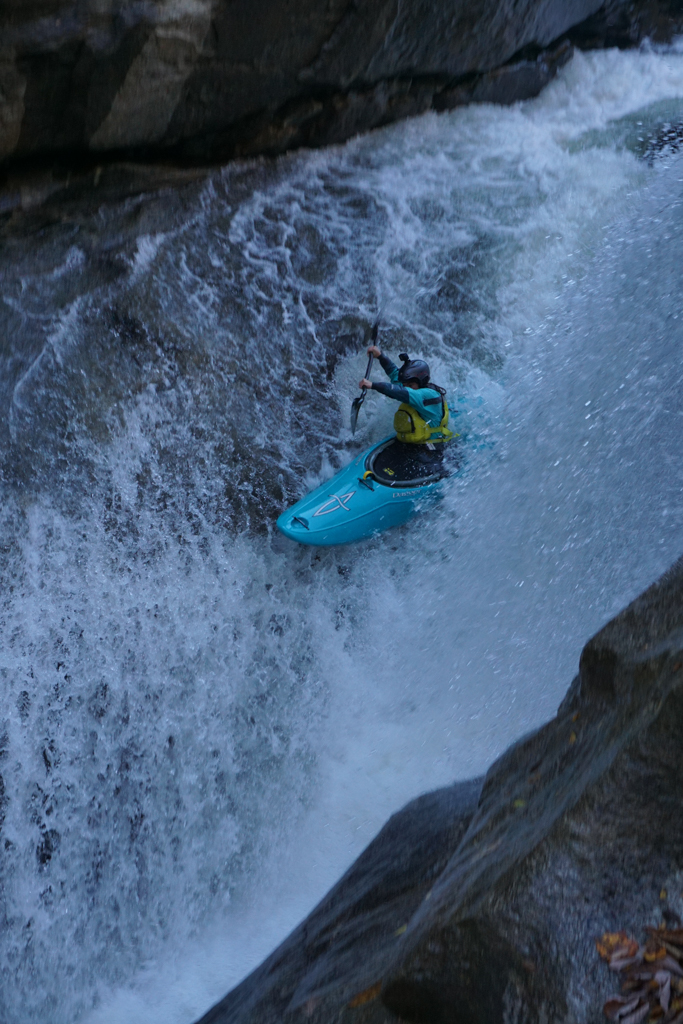
Gorilla, as she is affectionately known, is a 20-foot-tall, two-stage drop waterfall, and it’s the narrowest part of the Narrows. The force of the water spouting through this notch resembles that of a great, horizontal geyser. This is the climax of the Green Race. On a normal year, up to 3,000 spectators hike in to perch on the rocks above Gorilla and watch racer after racer launch themselves over the falls. The spectators scream at the top of their lungs. They’re hungry for carnage and glory. On race day, the gorge is an arena, and the cheers from the crowd echo off the rocks and mix with the din of the falls to create a deafening roar.
Paddlers say it’s like being a gladiator entering the Colosseum.
Above Gorilla, on river left, Grace’s crew members test the strength of a makeshift broadcasting tower, a rickety, three-story-high scaffold, by giving it a hard series of shakes. It sways a little, but the crew seems satisfied. On river right, men scamper in and out of the woods, bushwacking over downed trees, running equipment and wires down to the riverbank. The day before, Grace and his team ran a 3,000-foot fiber-optic cable into the gorge from a house at the top of the canyon.
“We might not be able to run Gorilla on Saturday,” Grace says to his organizing partner, Hale, while the two peer down at the ape. “The water’s going to drop.”
Helene’s Scourge
The Grace family has a cabin in the Green River Cove, and last September, Grace watched the Green spill over its banks and rush into his yard in a matter of minutes. The river, which on a typical day is about 18 inches deep and 600 feet from his front porch, rose to 30 feet at the high-water mark and came within 50 feet of his cabin’s foundation.
He watched homes on fire float down the river, past his front door.
When the water receded, Grace and dozens of other paddlers in western North Carolina jumped into rescue and recovery mode.
Grace was the first person to hike out of the cove, a steep three-mile-ish trek over landslides and crumbling roads to the nearest gas station. When he made it to civilization, no one at the top of the gorge knew the extent of the damage.
Helene destroyed nearly 40 houses in the Green River Cove, and after checking in on his neighbors, Grace found many were in trouble. But when he reached civilization that first day, he soon realized it wasn’t just the Cove that was hit hard. The entire region was in a blackout. Power, internet, cell service and credit card machines were down. Emergency resources were stretched thin. No one was coming for them.
The following day, Grace hiked up again, this time with messages from the people stranded down below.
The messages were dire: a handicapped child needed medical attention, a diabetic’s insulin and a man’s oxygen tanks washed away with their houses.
Oh my God, people are going to die if we don’t figure something out, Grace realized.
At some point on his second trek, he made contact with a rescue team, and in turn, they gave him a mission. They were sending in a helicopter at 4 p.m and told him, “If you can get people to the landing zone (which would be in Grace’s front yard), we’ll get them out.”
Grace, along with any able-bodied person in the Cove, most of whom were paddlers, jumped into action. They set out on foot, bushwacking over landslides and hiking through steep mountain roads with chainsaws in hand to clear a path. They piggybacked people over bridges, doing everything they could to get people to the landing zone.
That day, Grace and the Cove locals managed to medevac 22 people. The next day, they rescued another 20.
And it wasn’t just Grace who took action.
Paddling instructor and Cove resident Chris Wing, along with Erica Shanks, the Green River Keeper, organized a rescue and relief effort in the town of Saluda, and dozens of Green River paddlers joined the ranks of their small army to help their neighbors.
Cove local, paddler and Liquid Logic Kayaking founder Shane Benedict helped clear roads with chainsaws down in the Gorge.
Another longtime Green devotee, nurse practitioner and former North Carolina District 11 congressional candidate, Chris Harjes, was among a group of paddlers who participated in a reconnaissance mission to recover a full truckload of supplies from the middle of the South Toe River. The relief truck’s brakes burned out going down a steep mountain road, causing the vehicle to launch off an embankment, fly through the air and land more than halfway across the 150-foot-wide waterway below.
First responders were able to rescue the driver from the vehicle, but the trailer containing a massive load of food, tools, clothing, generators and supplies remained stuck in the river. Thanks to a little ingenuity and a raft, Harjes and some paddling compatriots were able to paddle out into the middle of the current and ferry most of the truck’s supplies back to dry land. Those supplies then safely made their way to their intended destination, Byrd’s Chapel near Burnsville, North Carolina. There, volunteers set up an impromptu grocery/hardware store with tons of supplies, showers, and access to a satellite phone so hurricane victims could make contact with the outside world. All of this was free of charge and supported by volunteers and donations.
A year later, recovery efforts have stagnated.
North Carolina leaders estimate the storm caused $59.6 billion in damage to the state, yet recovery dollars pale in comparison. As of November 2025, state and federal recovery funding has topped out at $5.2 billion, less than 9% of total funds needed.
When Helene came up through the Gulf of Mexico and hit the Southern Appalachians, like all cumulonimbus clouds trying to scrape over the tallest peaks east of the Mississippi, it dumped water down on the mountains. This weather pattern has played out for millennia in western North Carolina, and it is what makes the region a temperate rainforest.
Except, when the 500-mile-wide Helene hit, it rained an ocean’s worth of water, and steep mountain gorges and rivers like the Green served as giant funnels where mountainsides, buildings, bridges and more were slammed with gargantuan sheets of water. Liquid avalanches that crumpled steel beams like straw wrappers.
Statewide, Hurricane Helene officially killed 107 people (though locals assert that is an undercount). Tens of thousands of homes were damaged or destroyed, and water and power took weeks, sometimes months, to return to the hardest-hit North Carolinians.
Nothing could have prepared any North Carolinian for Helene, but paddlers were more ready than most. At the highest levels, not only do paddlers have to be skilled boaters, they have to be skilled rescuers as well. The river is a dangerous place.
Most who run hard whitewater, if they’ve been doing it long enough, will lose people to the river. Some have been there and pulled their friends’ bodies out of the water.
Former professional kayaker and Green Race legend Chris Gragtmans has been paddling the Green for decades, and one of his close friends died on the Green near Gorilla. In total, he’s known 26 people who’ve drowned while paddling. And he’s not unique.
Because of the immense consequences of the sport and the fact that, at the highest levels, it can’t be done alone, paddlers are some of the most tightly bonded athletes in the world.
Gragtmans likes the expression that when you squeeze someone, what’s inside them comes out. He’s seen his friends, when shit hits the fan, act heroically. He himself has performed heroic acts. He believes there’s a special kind of covenant that forms amongst friendships forged in whitewater. It doesn’t exist in many places on planet Earth, Gragtmans says, but it does in the Green River Gorge.
It’s the rain that makes this place special. But in September 2024, it was the rain that killed 107 people in North Carolina and washed three flood victims’ bodies into the Cove.
The river giveth, and the river taketh.
It’s an addiction, a religion and the single most powerful gravitational force in every paddler’s life. The river dictates where they live, how they work and whom they love. It sculpts their bodies and reorganizes their brain matter, morphing them into machines, custom-built for performing at the outer edge of possibility.
The closest pop culture frame of reference for hardcore whitewater boaters might be big wave surfers. The sport attracts adrenaline junkies — people for whom cheating death is a powerful drug. But there is a gravitas these athletes share as well — a deep understanding of the sheer magnitude of water. Perhaps it comes from the kind of acuity one develops when they’re held underwater for too long by forces outside of their control. Knowing what it would be like to die.
Paddlers are at once buoyant in spirit, rich in endorphins and keenly aware of the high cost of loving their sport.
Gragtmans once met famous big wave surfer Garrett McNamara at the 2011 Teva Mountain Games. He didn’t know who McNamara was at the time, but he had just broken a world record surfing an 80-foot wave in Nazare, Portugal. McNamara was standing in front of a bunch of posters, and it slowly dawned on Gragtmans that the tiny speck surfing down the massive wall of water in the pictures was the man in front of him.
“Wait, is this you?” Gragtmans said.
“Yeah, bro!” McNamara replied.
“Oh, crazy! I’ve just run a 90-foot waterfall!”
The two immediately hit it off.
Many paddlers, as they age, decide the cost isn’t worth it. They take up less dangerous sports. Sometimes it takes one near-death experience or the death of a friend. Sometimes many.
But the men and women who stay eventually have to justify this paradox — what makes them feel more alive than anything in the world is what’s most likely to kill them.
Gragtmans contemplates that paradox often, especially now that he’s a father and husband. But for the boaters who can’t quit class V, removing the river from themselves would be akin to amputating their own limb. It is an integral part of their lives, and one they won’t part with lightly.
In 2024, Gragtmans started a nonprofit he named Bright Shadow, in part, to wrestle with the parts of the sport that trouble him. The organization hosts retreats, workshops and community events dedicated to helping people heal from nature-related trauma.
Originally, he envisioned extreme athletes, wildland firefighters or first responders as his target audience. But when Helene hit, his prescient mission suddenly became relevant to everyone in western North Carolina.
After a lifetime of traveling the globe to tackle the world’s wildest rivers, Gragtmans has found another all-consuming task — to help people heal from the same things he’s gone through. The open-hearted ethos he’s developed after decades of experiencing the sport’s highest highs and lowest lows posits a counterpoint to the swaggering, egotistical archetype of the young extreme athlete. He doesn’t want to be the trauma guy, but if no one else is going to talk about it, he will.
The New Gorilla
On Oct. 30, 2025, two days before the Green Race, Gragtmans was among a group of eager paddlers who’d ventured onto the Green to test the river at the highest level it had been in months.
Somewhere in the Gorge, Grace was bushwacking through the forest, wrestling with fiber-optic cable logistics. On the river, Gragtmans contemplated a move he’d only dreamed of.
Since he was a teen, he had looked at the left-hand ledge of the rapid and wondered what it would be like to huck it over that side of the falls. Though there are many ways to approach a rapid, before Helene, most paddlers went right and let the flume-like current spit them downriver over Gorilla. But there is a line to the left, which was all but impossible before Helene.
Gragtmans imagined all of the ways he could mangle his body, taking the left line, which up until recently only slightly outweighed the allure of the fantasy.
But when Helene came through and blasted the river to smithereens, it reorganized the rapids and rocks that had once been so ingrained in the minds of the Green’s devotees. Now, the line is possible. Dangerous, but possible. Earlier in 2025, young paddler Nathan Anderson sent the left line and proved it was navigable. He named it “The Dragon Line.”
The river gauge read 12 inches on Thursday morning. It was as high as the water would be all week.
Gragtmans paddled in with a group of friends and paused at the top of Gorilla. The Dragon Line was looking good, and Gragtmans got out of his boat to scope it out.
Paddling uncharted territory, which the new Gorilla was, is tricky business. It requires painstaking calculations. If I take this route, will the landing below paralyze me? At which point exactly should I take a paddle stroke? Should I bump into this rock sideways or head-on to put myself in the best position?
Gragtmans and his friend Andrew Holcombe contemplated the risks. It was possible that Gragtmans could corkscrew off the ledge, flip right and land on his head. He and Holcomb, both highly experienced paddlers, decided that was unlikely. He asked his crew if they were OK with this. Not everyone wants to watch someone attempt something so dangerous. They all agreed they were cool.
After about 20 minutes of what looked like serious deliberation, a paddler in Gragtmans’s crew suddenly sprinted downriver. Gragtmans, in his deep red drysuit, blue boat slung overshoulder, scampered upstream. He was about to send it.
The paddler downstream, Gragtmans’s friend Snowy Robertson, pulled out his phone and steadied himself on the rocks at the egress of Gorilla. Several other paddlers scattered around the rapid, readying themselves for a possible rescue.
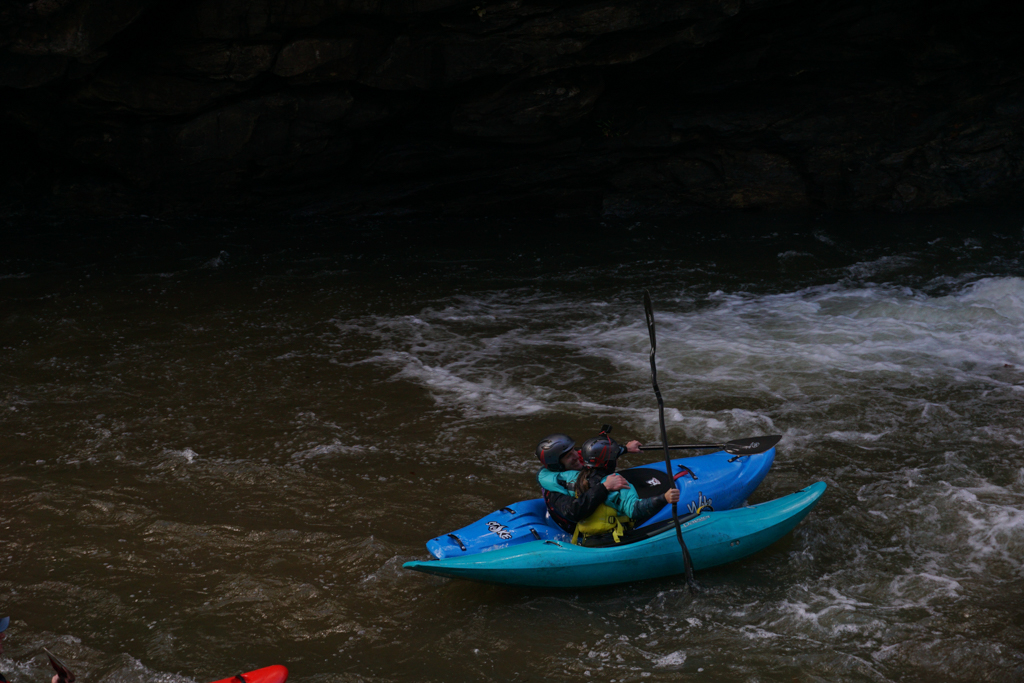
Soon, Gragtmans’s blue boat darted across the horizon, and in an instant, he was airborne. Three, four, five feet over the falls, he launched over the rapid, skirted off the rock shelf to his right, ricocheted into the swirling pool below, and landed backwards in his boat. He made it. Everyone watching erupted in cheers.
Gragtmans was the second person ever to take the Dragon Line, and he nailed it. Just one week before, he turned 40, and at his age, he didn’t expect to be taking risks like this. The line he’d been dreaming of since he was a kid, he managed to run exactly as he had imagined it in his mind’s eye. It was one of the highlights of his career.
After Gorilla, Gragtmans raised his paddle over his head and whooped with joy. His friend, and 14-time Green Race champion Adriene Levknecht, sidled up to him in her kayak in the eddy downstream for a forceful hug.
A Shifting Tide
A year ago, many thought the river was toast. Helene destroyed the power station on Lake Summit upstream that used to supply steady water releases to the Narrows 300-plus days a year. Several paddlers moved away in search of better training grounds, and many were too traumatized to get back in the water. Rescuers recovered three bodies in the gorge after the flood, according to Grace. Dozens lost their homes and all their belongings. The sacred place had been tainted.
Slowly, though, hope has been building. Intrepid paddlers began probing into the gorge after the flood, and much to the community’s surprise, the Green was running.
In November 2024, instead of a race, Grace and his fellow organizers put on a river clean-up, and hundreds showed up to pitch in. It was like a funeral. They gathered there to celebrate their sacred holiday and grieve their immense loss.
At the clean-up, Gragtmans read a poem he’d written to “Mama Green,” and by the time he finished, the crowd was in tears.
“This wreckage is fertile ground, and it is tilled by each of our individual memories that may feel in this moment like crushing losses,” his poem read.
“The Gorilla didn’t go down without a fight, but you know what? She’s hurt; she ain’t dead.”
Just after the clean-up, Gragtmans and his long-time friend Pat Keller, one of the greatest kayakers alive, thought the community needed a win. The two set out to run the first descent of the new Gorilla. It worked. They posted their exploit on social media, and thousands reacted in awe.
It’s undeniable, though, the rapids are different. They’re sharper and gravellier. It hurts more when you smash into a rock. The once smooth, river-worn natural waterpark so many flocked to since the late ’80s is now jerky and stop-and-go. The once flowing faucet’s been reduced to a meager trickle much of the year. Some rapids are unrunnable now.
Despite this, on Halloween, on the Green Race eve, the river is more crowded than it has been in over a year.
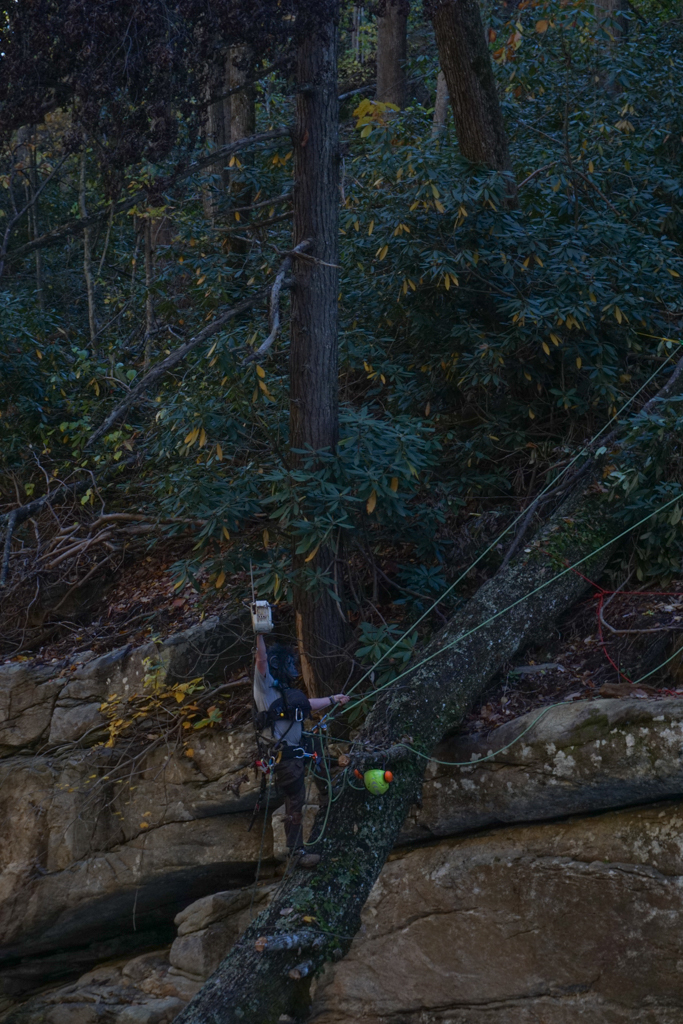
Corey Volt, professional kayaker and member of Grace’s production crew, dangles above Gorilla with a chainsaw in hand. He’s strapped into a climbing harness and cutting branches from the fallen tree that now hangs above Gorilla.
Dozens of boaters plunge in and out of the racecourse, practicing their runs for tomorrow. Between their laps, the paddlers pitch in to clear the branches Volt cuts from above.
Before he climbs off the tree, Volt shoves a shaggy gorilla mask over his head, raises his chainsaw high, and revs the engine to the cheering crowd below.
Race Day
Finally, it’s race day, and kayaking’s Christmas morning is quieter this year. Just a few hundred or so spectators line the banks by Gorilla. Only 81 paddlers showed up at the starting line. The water has dropped from 12 inches earlier in the week to three inches today.
Before the race, paddlers spoke of this event with a hitch in their throat. They recalled what it had been and measured it against what it is now, and in their voices lay the particular, dejected tone of heartbreak.
Today, though, Grace’s optimism has infected the crowd. And it really should come as no surprise (though it does). He and his comrades are accustomed to pulling off the impossible.
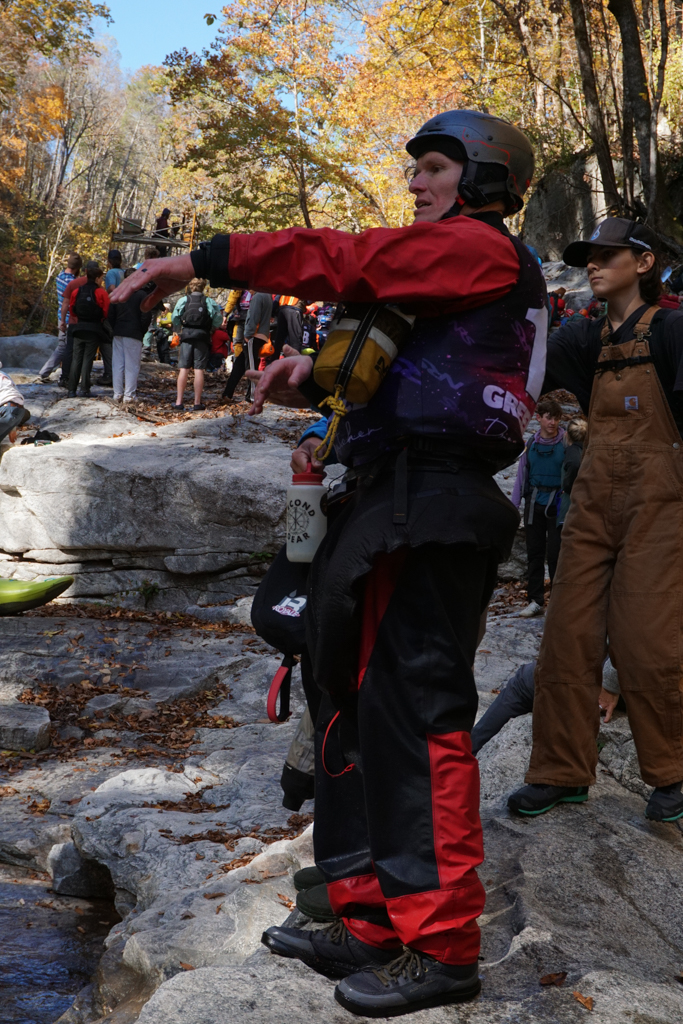
The water has dropped, but the stoke has risen. The energy is palpable.
Every few minutes, a breeze sweeps through the gorge and shakes the speckled yellow and orange leaves from their branches, and they float down, carried by the wind, slowly toward the river like confetti.
The sun is high, and the smell of the clean, cold water permeates the air.
On the paddle in, Grace and Volt spotted a blue heron sunbathing above the Narrows. A good omen. Some paddlers say the birds represent friends they’ve lost on the river over the years, watching over them.
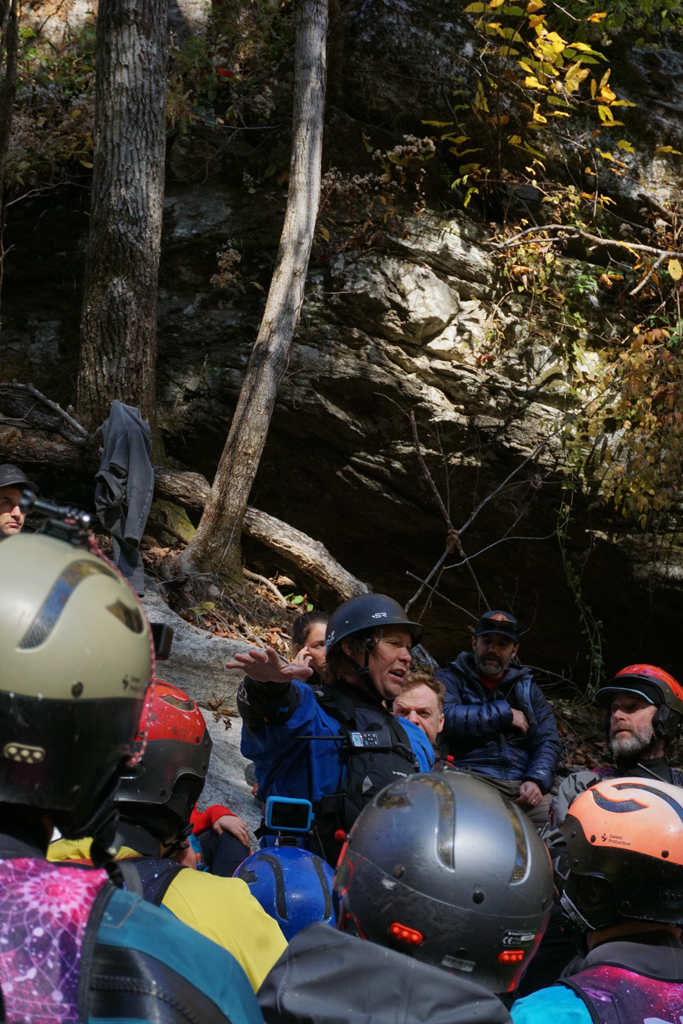
Gragtmans smiles and bear hugs fellow contestants, catching up after what has been an awful hiatus. Above Gorilla, Grace wears a royal blue drysuit. His shaggy hair, wet from the river, sticks out from the edges of his helmet as he delivers race instructions to the multiple generations of paddlers before him. Today he stands as a river sage, but it’s easy to imagine him as the kid who first fell in love with the Green decades ago.
The race is different this year. Grace and the other organizers have rearranged the competition. The course is shorter, and the format has shifted from paddlers getting one go to make their way downstream as fast as they can to a multi-stage, head-to-head competition.
The once ruthless Gorilla arena has taken on a more congenial tone. Paddlers mill about, sharing cans of beer and bowls of weed.
Gragtmans joked that Grace hasn’t just made lemonade out of lemons — he’s made margaritas.
It’s not as intense as years past. The crowd isn’t as big, and the river is low and slow. But the mere fact that they’re racing at all is a win.
Alex Perri is a graduate student in journalism in the Grady College of Journalism and Mass Communication at the University of Georgia.

Great article Alex!
I felt like I was actually there. It brought back a lot of memories of kayaking as a teenager. Thanks for making my day!
Great article. I just watched a documentary on the Helene flooding and it was terrifying. These kayakers were unsung heroes thanks for sharing.