From 5-25 to Contenders: How a Throwing Program Rebuilt Madison County baseball

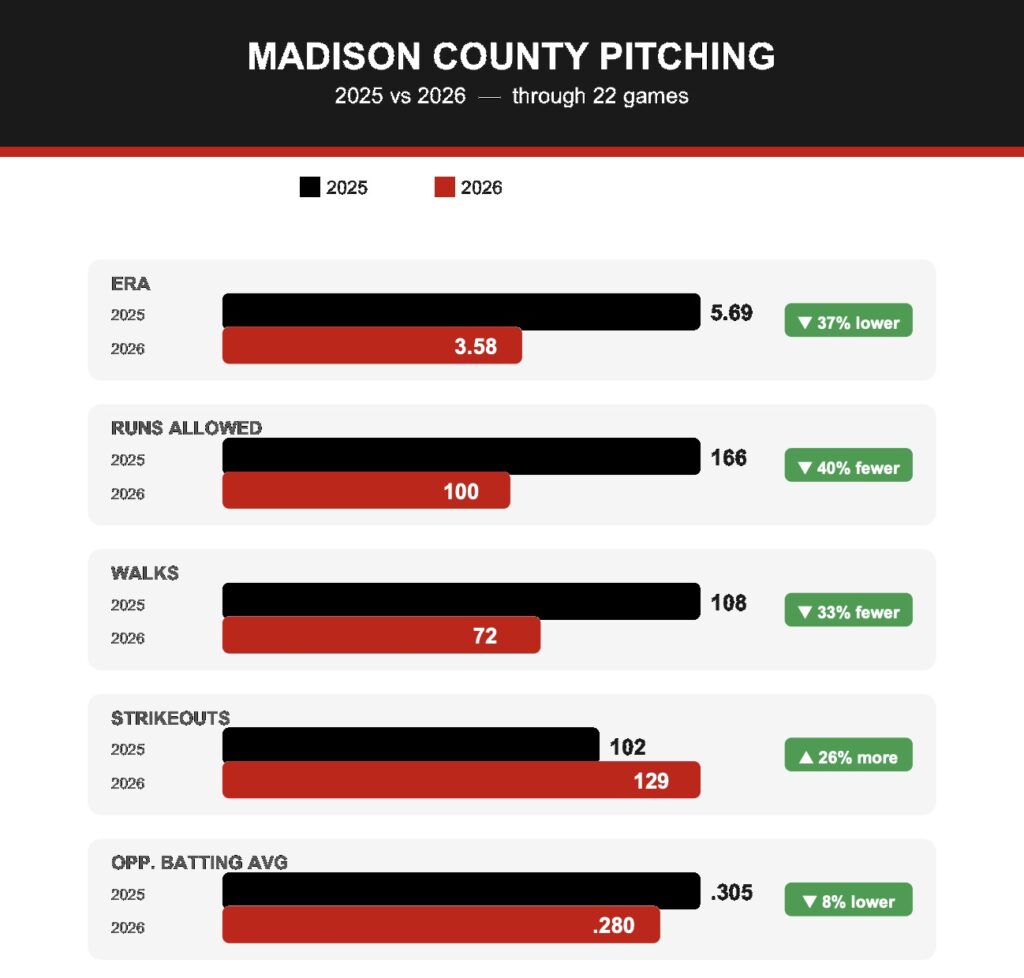
Last spring, Madison County pitchers were knocked off the mound early and often. The Red Raiders finished the 2025 season 5-25, with a team ERA of 5.69 and 166 total runs in just 30 games.
This season, Madison County is 14-12 with a team ERA of 3.58 and just 100 runs allowed, a complete turnaround.
This surge comes after second-year head coach Colin LoCurto introduced a structured offseason throwing program focused on consistency, strength and workload management. The approach has improved velocity, command and depth on the mound, while reflecting a broader emphasis on development and injury prevention in youth baseball.
The program begins late in the summer and follows phased eight-week progressions, mixing harder- and easier-intensity days to allow for development and recovery.
The only thing I do is tell them their max [throwing] distance for the day,” LoCurto said.
“It’s high [intensity] then low [intensity], and we vary that on a week-to-week basis. In the end, we build up as we go on and throw bullpens.”
The program also stresses player accountability when coaches aren’t present to achieve results.
“The biggest thing is just the autonomy that we have to have from the players to take it and run with it because if they’re not willing to work as hard as they can themselves, then they’re not going to get anything from the program,” LoCurto said.
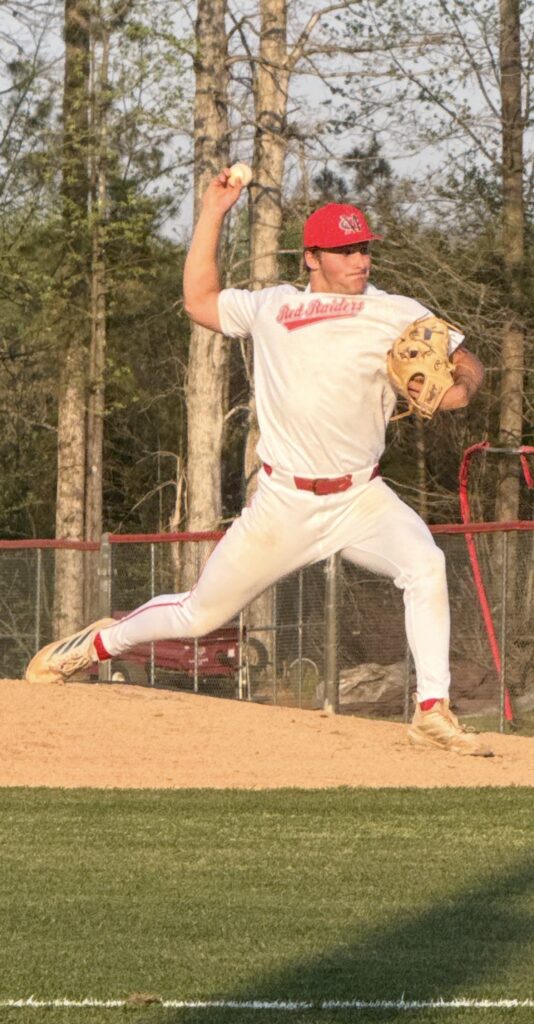
For Madison County junior Hampton Rowland, the impact of the program has been clear. As a catcher, pitcher and utility player, Rowland noticed growth in his performance on the mound.
I’ve gained a good 5-7 mph on average… that’s huge for me,” Rowland said.
Rowland also acknowledged the changes were noticeable across the roster, especially among younger pitchers.
“The stuff [LoCurto] brought was new and fresh, but it also made sense, and you could see the results were clear with some of our younger guys, who in one offseason, they jumped 10 mph on the mound,” Rowland said.
Rowland’s numbers reflect the program’s results, but not every offseason throwing program produces the same outcomes. Glenn Fleisig, a biomechanics researcher at the American Sports Medicine Institute, studies pitching injuries and biomechanics, and he has seen numerous problems with youth pitching.
“The No. 1 issue is velocity: throwing all pitches as hard as possible,” Fleisig said. “The science shows that you can’t throw all your pitches as hard as possible, whether you’re a high school pitcher or a major league pitcher.”
Fleisig also pointed to pitchers throwing too many pitches, playing for too many teams and ignoring fatigue.
The injuries are not muscles, they’re ligaments and tendons, and ligaments and tendons are tiny compared to the muscles,” Fleisig said. “Unfortunately, they don’t recover as well as muscle.”
For Madison County, coach LoCurto acknowledges these risks and built his throwing program with these consequences in mind. As a former college baseball player at Georgia College and State University, LoCurto is well aware that pitchers cannot rush development.
“If you try to max out without building up, you’re putting yourself in danger,” LoCurto said.
Mark Hyman, a journalism professor at the University of Maryland who has written extensively about youth sports cultures, saw his son suffer from a serious arm injury.
In his book, “Until It Hurts: America’s Obsession with Youth Sports and How it Harms Our Kids,” Hyman critiques the high-pressure of youth sports, arguing it often pushes athletes beyond their limits and leads to overuse injuries. Additionally, Hyman talks about his experiences with his son and how he impacted his son’s youth sports tenure.
“I began to kind of examine what my motives might be, and question how I had gotten to a place where I was putting my ambitions for him above what was in his interest,” Hyman said. “Your child should not need a new elbow at age 17.”
With kids playing on numerous teams and year-round, the risk of injury skyrockets, and much of it is due to parents.
“Many parents lose their balance and their compass, even though they’re great parents,” Hyman said. “They just get caught up in something that affects their judgment.”
Madison County’s throwing program seems to be going against all of the possible negative outcomes described by Fleisig.
Pitching is a science and an art,” Fleisig said. “[Madison County] might be an example of a team that is balancing and doing the right amount of training and exercise.”
The results are evident on the field for the Red Raiders. Rowland has seen the outcomes behind the plate as a catcher this season.
“It’s been amazing and refreshing as a catcher,” Rowland said. “Guys are filling up the strike zone.”
After struggles last year, Madison County now has numerous options on the mound. As the Red Raiders prepare for the first round of the state playoffs April 22-23, their turnaround in just one year is built on sustainability and structure, two factors that could carry them well beyond this season.
Evan Waldman is a student in the undergraduate certificate program at the John Huland Carmical Sports Media Institute at UGA.