ANNOTATED: Reflecting on Turning Point USA Photo Essay with Parker McCollum

Reporter Annotations are meant to get to the how and why behind Newsource’s reporting through in-depth conversations with the reporters themselves. Read the conversation below for how third-year journalism major Parker McCollum reported a photo essay titled, “Protesters Gather Outside Turning Point USA Event with JD Vance in Athens.”
This interview has been edited for length and clarity.
Perri: To start, can you tell me a little bit about yourself and your journalism experience so far?
McCollum: I’m a third-year journalism student, and this project was part of my work through Grady Newsource. I originally got into journalism thinking I was going to focus mostly on print, but then I started doing video and kind of fell in love with cameras and visual storytelling. I had done photography casually before, but videography really made me realize how powerful visuals can be in telling a story. Since then, I’ve taken video classes through Grady Newsource and tried to build experience across different mediums.
Perri: How would you describe yourself as a journalist? Are you mainly a writer, a photographer, or more of a multimedia journalist?
McCollum: I think “jack of all trades” is probably the best way to describe it. I think that’s what journalism increasingly requires. On almost every story, you’re gathering a little bit of everything — photos, video, interviews, vertical clips for social media, quotes for print stories. I really love photography, and I really love writing, but I know you have to be able to do more than one thing.
Perri: How did you end up covering the Turning Point event?
McCollum: I actually wasn’t assigned to it. We knew it was a big breaking news event, and I messaged Dr. (Amanda) Bright and asked if anyone was covering it specifically from a photography standpoint. She checked and said no, so she gave me the green light.
I had only done one photo story before this, so going into it I was definitely nervous. Photographing an event like this is very different from shooting landscapes or still subjects. But I wanted the opportunity to try.
Perri: I’m honestly surprised this was only your second photo story. These look incredibly professional. What was your approach going into the event?
McCollum: Thank you. Going in, I tried to pre-visualize certain moments I wanted to capture. When you think about protests, you think about emotion, movement and tension, so I knew I wanted to capture that.
At the same time, I also wanted to pay attention to the quieter moments inside this huge crowd. One of my favorite photos is of a mother holding onto her child during the protest.
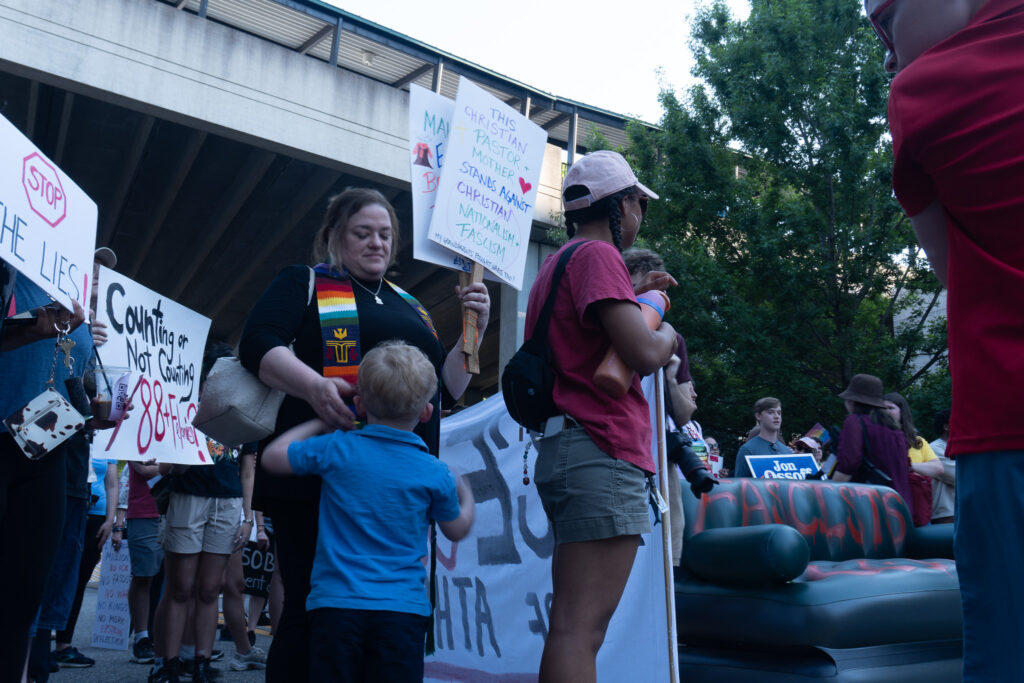
Another is of an older man named Duke holding a sign with lyrics from a Buffalo Springfield protest song. I stopped and talked to him for a while and learned he was a Korean War veteran. Those smaller human moments really stuck with me.
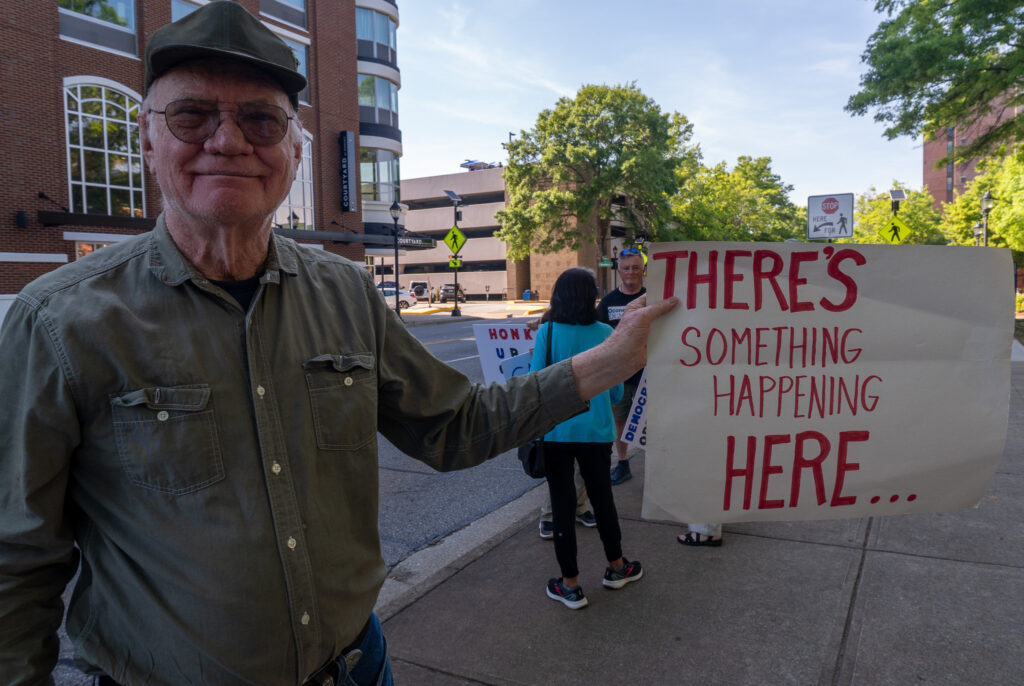
A lot of it was learning as I went, which was a little terrifying, but also really rewarding.
Perri: One photo that stood out to me was the image of police officers on top of the Classic Center. What made you want to include that?
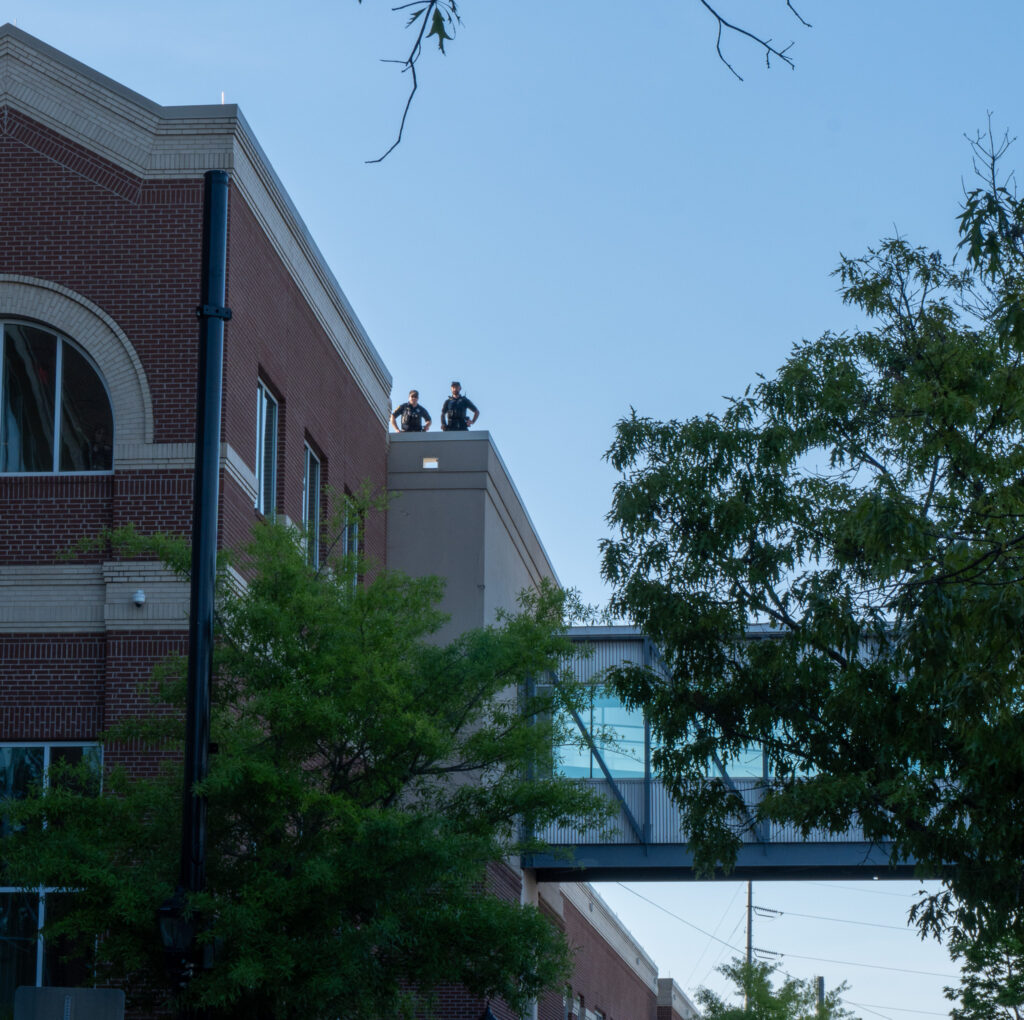
McCollum: I really wanted that image in the gallery because it captured how intense the security presence felt. There were Secret Service agents everywhere, SWAT officers in full gear, police monitoring the area from rooftops.
At one point, I tried to go to a nearby parking deck to get an overhead shot, and within seconds, an officer came over and told me I couldn’t be there. Even just covering the event, I felt very watched and surveilled the entire time.
Perri: That brings up an interesting question. You mentioned feeling surveilled while also holding a camera yourself. Did that dynamic ever cross your mind while photographing people?
McCollum: Yeah, definitely. Early on, there were honestly more journalists than protesters, and you could tell some people were uncomfortable with that. But as more people arrived, I think many realized the media was there to document their perspective, not attack them.
People became really willing to talk. I’d walk up and start conversations while taking pictures, and most people were open and eager to share why they were there.
Perri: What was the overall atmosphere like that day?
McCollum: At first, it felt small and a little awkward because there was so much media there. But as the crowd grew, the energy started building.
Once speakers started talking, everything got louder and more intense. Later, when Turning Point attendees and protesters started crossing paths more directly, things got chaotic. There was a moment where people were yelling at each other and emotions were really high.
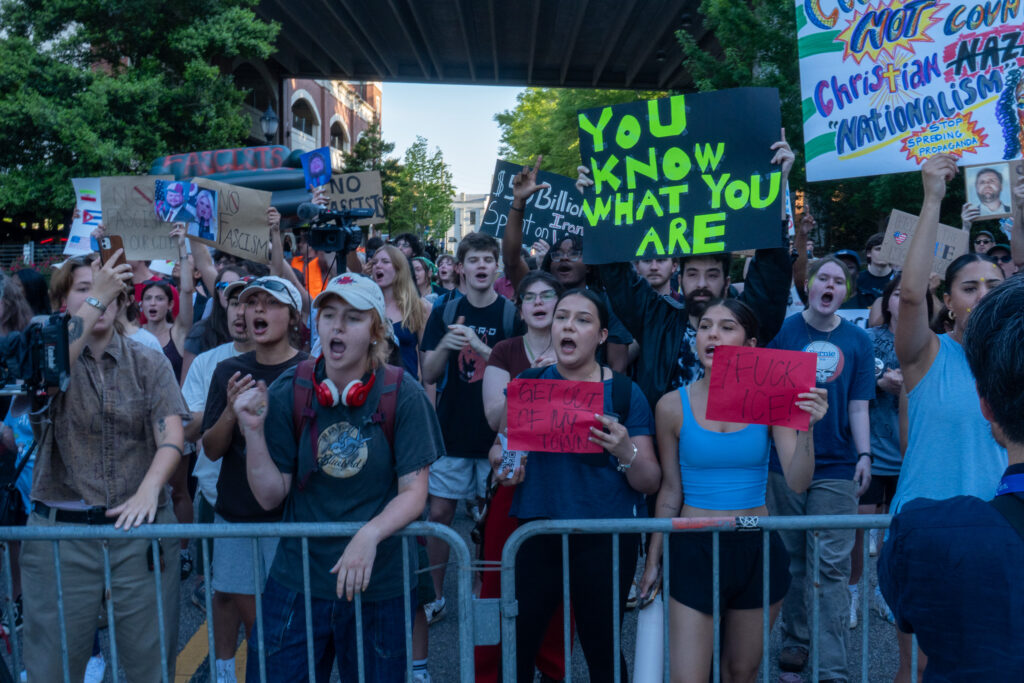
I genuinely got nervous at times because you were moving through tight crowds trying to photograph everything while also staying aware of what was happening around you. Thankfully, things calmed down by the end.
Perri: What kind of preparation went into covering an event like this as student journalists?
McCollum: There was actually a lot of planning. Our professors wanted to make sure nobody was covering the event alone, so there was a rotating schedule, and people were constantly checking in with each other.
Professor (Jen) Duck especially emphasized safety. She had covered protests before and talked to us about situations where things escalated quickly. She reminded us to stay aware, stick together and be prepared for anything.
I even packed snacks and water in my backpack beforehand just in case we were out there for hours.
Perri: It sounds like a pretty professional environment for student journalists.
McCollum: It really was. One of the coolest parts was getting to interact with professional journalists covering the event too.
At one point I started talking with another photographer and realized he was shooting for the Atlanta Journal-Constitution. We talked about camera angles, framing and techniques. Getting advice from someone working professionally in the field was really valuable.
Perri: Looking back at the gallery now, are there any images you’re especially proud of?
McCollum: Definitely. There’s one photo where someone is carrying a green couch with an anti-fascist message on it, and the expression on the subject’s face is just visually striking.
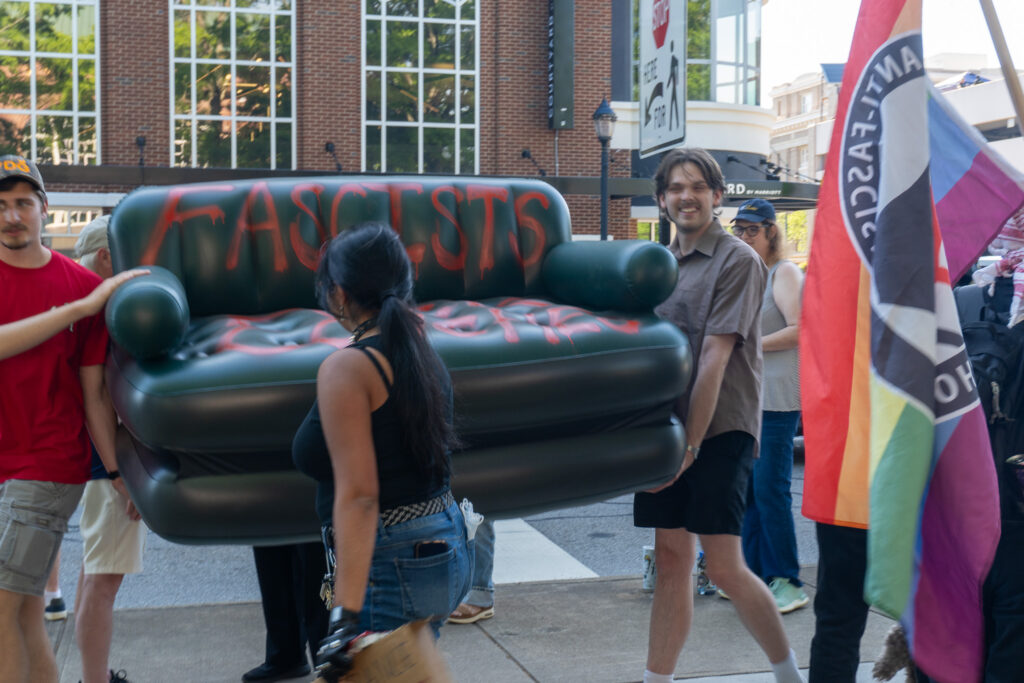
I’m also proud of the image of Duke, the Korean War veteran. I think it shows the range of people who were present at the event — younger students alongside older generations.
But my favorite image is probably the one of a woman moving quickly through the crowd during one of the most chaotic moments of the protest.

Perri: Why is that one your favorite?
McCollum: I think photography has a unique ability to distill emotion into a single second. Video can show movement and context over time, but photography freezes a moment and forces you to sit with it.
That image captures tension, motion, worry and energy all at once. The lighting helped too — it was basically golden hour — and all the different colors from flags, signs and clothing came together in a really striking way.
Perri: Did you receive any memorable feedback about the photos after they were published?
McCollum: Yeah, actually. One woman messaged me on Instagram asking for a photo of her to be removed because she felt the post made it seem like she was a protester, which she said she was not.
After talking with my editors, we agreed she had a fair point. On Instagram we couldn’t individually caption each image the way we could on the website, so we removed the photo from the social media post out of caution.
That experience taught me an important lesson about clarity and representation in captions and context.
Another thing I learned involved photographing signs with profanity on them. Some of my favorite shots included language that wasn’t appropriate for our publication, so we decided not to publish those photos. That made me think more carefully about framing and composition moving forward.
Perri: What do you think you’ll take away from this experience moving forward?
McCollum: Honestly, one of the biggest lessons was realizing that approaching people isn’t nearly as scary as I thought it was.
I’m naturally a pretty shy person, but this event forced me to walk up to strangers, ask questions and start conversations constantly. And most people were genuinely excited to talk and share their perspective.
That was a huge confidence boost for me.
Perri: Was there anything else you learned during the event that surprised you?
McCollum: I learned the importance of knowing when to focus on the visuals and when to listen.
There were moments where classmates overheard someone mention they had been kicked out of the event, and that immediately turned into an interview opportunity. You had to constantly balance paying attention to the scene visually while also listening for conversations and stories happening around you.
That was something I hadn’t really thought about before covering a live event like this.
Perri: What’s next for you?
McCollum: This summer I’m going on a Grady study abroad trip to work on a World War II documentary project in Normandy.
We’ll be visiting the D-Day beaches and other historical sites in northern France. It’s serious subject matter, obviously, but I’m really excited for the experience.
Perri: That sounds incredible. Thanks again for taking the time to talk.
McCollum: Thank you.
Alex Perri is a graduate student in the journalism program at the Grady College of Journalism and Mass Communication.